Should you change your workouts based on your menstrual cycle?
Cycle syncing has become a popular trend, but the latest research suggests following a training schedule dictated by your menstrual phases is not necessarily the smartest approach. So what should you do instead?
Quick answer: You do not need to follow a strict cycle syncing workout plan. Research suggests menstrual cycle symptoms can affect how exercise feels, especially before and during your period, but most women do not need to change their entire training plan based on cycle phase. A more useful approach is to track how you feel, adjust intensity when symptoms are strong, and keep training flexible.
Periods can be a pain. Cramps, mood shifts, and the constant hassle of bleeding can make everyday life challenging, and working out can feel even tougher. This is where cycle syncing comes in.
What is cycle syncing? Cycle syncing involves adjusting your exercise to align with your menstrual cycle and choosing specific workouts for specific phases of your cycle. It’s become a popular trend among female exercisers, but health and fitness professionals have questioned if it’s really worthwhile.
So, is it…?
Let’s start by addressing the main issue … High-quality research in this space has been pretty thin on the ground. For decades, exercise science was built largely on male physiology. Before the 1980s, fewer than one in five study participants were female, and many early theories about female physiology stemmed from single studies, often conducted with animals rather than with women.
What we do know is that hormonal shifts across the menstrual cycle may spark fluctuations in metabolism, body temperature and injury risk, with the evidence strongest for body temperature. Around 75% of female athletes report symptoms like cramps, back pain, headaches and bloating during their cycle. Yet newer research indicates the cycle has little impact on strength performance, and another study finds minimal impact on muscle protein synthesis after resistance exercise.
Dr. Jinger Gottschall, a fitness and wellness research scientist who specializes in women's health, notes that while monthly hormonal changes can affect mood, fatigue, and motivation to exercise, there is no universal training strategy that resolves symptoms for everyone. This is because menstrual cycle length, phase length, and ovulation timing vary greatly within individuals.
Gottschall, along with Dr. Gillian Hatfield and Les Mills Head of Research Bryce Hastings, recently led a study of 148 highly active women to explore how their cycle impacted motivation, stress, fatigue, and physical and emotional well being. Their findings, presented at the 2026 ACSM Health and Fitness Summit and currently pending publication, were clear: How women felt changed throughout their cycle, but how they trained did not.
The findings:
- Motivation, fatigue, stress, and symptoms fluctuated across the cycle; however women felt the most noticeable increases in physical discomfort in the days leading up to their period and during menstruation.
- In the late luteal phase (the days leading up to a period) and during menstruation, women reported lower motivation to exercise, higher fatigue, more stress, and physical symptoms such as bloating, headaches, body aches, breast tenderness, and digestive issues. They also noted more feelings of anxiety, moodiness, sadness and irritability. All issues consistent with common premenstrual (PMS) experiences.
- Despite feeling these fluctuations at certain points in the cycle, women generally exercised just as often for similar amounts of time and did the same types of exercise at similar workout intensities.
In short, women felt worse at some points in their cycle, but they generally kept training anyway.
Gottschall explains: “This suggests your menstrual cycle may change how exercise feels, especially around your period and just before it, but it does not need to dictate how you train.”
“The specific impact of each phase is different for everyone. And shifts in energy and mood are normal,” adds Hatfield. “Additionally, factors other than the menstrual cycle can affect your energy and motivation to exercise, such as sleep, nutrition, and other sources of stress in your everyday life. The important takeaway is to listen to your body and adapt exercise to suit your body and your mind.”
For most active women:
- It is helpful to understand and anticipate cycle-related symptoms.
- Feeling more tired or less motivated around your period is normal.
Rather than following rigid cycle-based training plans, it may be more useful to:
- Check in with how you feel each day.
- Adjust training when symptoms are significant.
- Stay flexible instead of following strict calendar-based rules.
What are the phases of your menstrual cycle?
As most women will know, your menstrual cycle starts on the first day of your period and ends when your next period begins. Usually, this is 28 days, but it can vary. Within your cycle, there are three phases:
What is the follicular phase?
This is the time between the first day of your period and ovulation.
What happens during ovulation?
This is halfway through your cycle when an egg is released from the ovary.
What is the luteal phase?
This is the time between ovulation and before the start of menstruation, when your body prepares for a possible pregnancy.
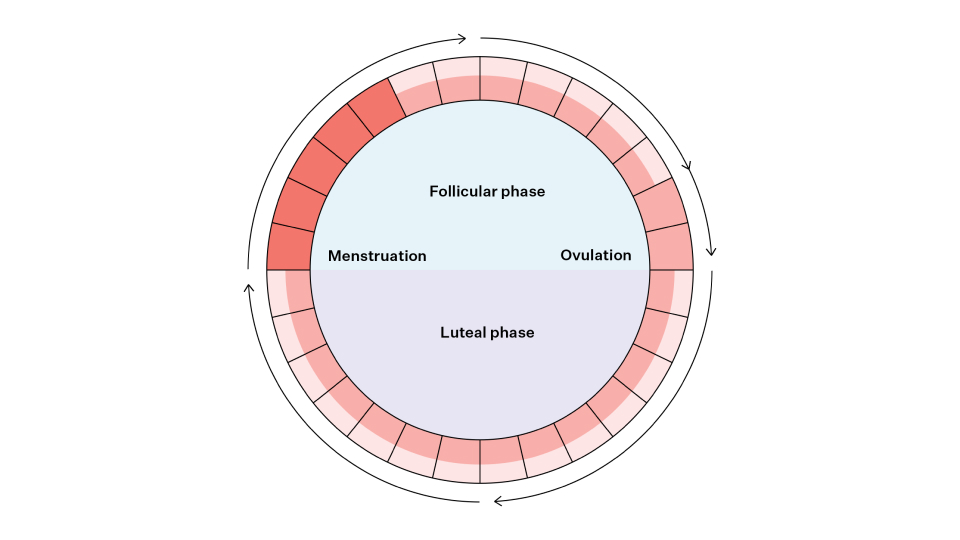
Each phase is fueled by hormones – four in particular. In the early stages of your cycle, a hormone known as the follicle-stimulating hormone (FSH) tells your ovaries to prepare and produce the egg-containing follicles. These follicles then produce the second hormone, estrogen, which rebuilds the lining of the uterus. Once the follicles are big enough and produce enough estrogen, the third hormone – luteinizing hormone (LH) – is produced. This releases the egg, which causes ovulation. In this final phase, the follicle that contained the egg begins to produce the fourth hormone, progesterone. It is progesterone that helps prepare your uterus for a possible pregnancy.
"The important takeaway is to listen to your body and adapt exercise to suit your body and your mind." Dr. Jinger Gottschall
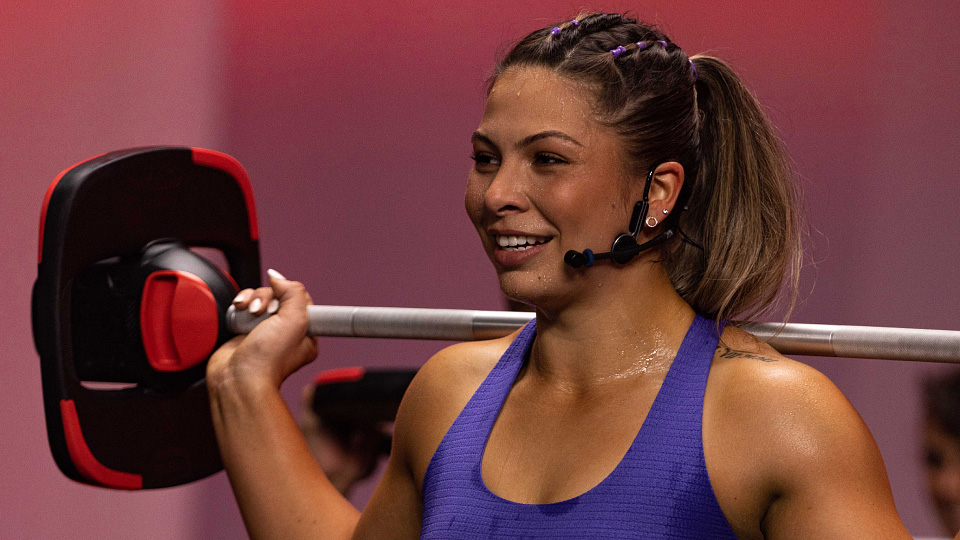
How should you align exercise with your menstrual cycle?
The information below describes patterns some women notice, not a schedule to follow. Use this information as a starting point, and let your symptoms, energy and how you feel guide your training, rather than the calendar.
How should you exercise during the early follicular phase?
At the beginning of your cycle, your menstrual hormones are low while you are menstruating. You may be dealing with symptoms like inflammation, pain and a good dose of lethargy. This is when you might want to be kind to yourself and train in a way that really nurtures your body and mind.
How should you exercise during the mid follicular phase?
As the follicular phase progresses, estrogen starts to rise. This is when your energy levels may start to pick up and some find a higher pain tolerance. Some women find this can be the perfect time to train harder and push through high-intensity workouts and strength training.
How should you exercise from the late follicular phase to ovulation?
As estrogen levels peak at the end of the follicular phase, so too can your motivation to exercise. In this phase, right before ovulation, you may feel motivated to train hard – though research shows measured performance varies little across the cycle, so let how you feel guide you, rather than the phase.
How should you exercise during the luteal phase?
After ovulation, your menstrual cycle hormones fluctuate fast. Energy levels can drop and you may be feeling heavier because of fluid retention. Some women find this is the perfect time to embrace longer, more steady-state training. You might like to focus on improving technique and movement efficiency, rather than pushing for a personal best. Some women also find gentler, recovery-focused activities like yoga, meditation and breathwork feel good during this phase.
Should you sync your diet to your menstrual cycle?
Some women may find it helpful to focus on iron-rich foods during menstruation and nutrient-dense meals across the cycle. However, nutrition needs vary, so the most useful approach is to prioritize regular meals, enough energy, and a varied diet that supports your training and recovery.
What should you eat during the follicular phase?
In the early follicular phase, during menstruation, fuel your body with iron-rich foods like legumes, seafood, red meat, nuts and seeds and choose meals with anti-inflammatory foods and antioxidants. Dark leafy greens, cauliflower and kiwifruit add useful vitamins and minerals too. Throughout the follicular phase, maintain energy levels with complex carbs like oats, legumes and whole grains. Mix with a variety of plant foods and high-quality proteins like fish and eggs to help recovery.
What should you eat during the luteal phase?
In the luteal phase, many find their appetite and cravings can increase, driven by rising progesterone and a small rise in resting metabolism. This is when it’s important to fuel your body with nutrient-dense foods and snack regularly. As this luteal phase progresses, start consuming more anti-inflammatory foods like fatty fish, tomatoes, dark leafy greens and berries.
In summary: What is the best way to train throughout your menstrual cycle?
We’re all different, so it’s important to explore what works for you.
Many women find the late follicular phase (the time between menstruation and ovulation) can be a good time to push, hustle, grind and break records. During the late luteal phase and menstruation, many women choose to scale back and do the type of training that nurtures your body.
It’s important to be aware that the shape of your cycle is unique – research shows cycle length, phase length, and ovulation timing can vary greatly within individuals and it can change month-to-month and at different points of your life. The hormonal shifts you experience in your younger years can vary later in life and there can be significant changes when you reach perimenopause and menopause.
What are the key things to remember?
- Explore different options rather than follow prescriptions
- Tailor intensity and impact as feels good for you
- Make recovery a key part of your training routine
Frequently asked questions about cycle syncing and exercise
Is cycle syncing backed by science?
Cycle syncing is popular, but research does not yet support a single workout plan that works for everyone based on cycle phase alone. The more useful approach is to notice your symptoms, energy, sleep, stress, and motivation, then adjust your training when needed.
Should you work out during your period?
You can work out during your period if it feels right for your body. Many women will continue with their usual training, while some feel better with gentle movement, stretching, walking, or low-impact exercise. If symptoms are strong, reducing intensity or prioritizing recovery can be a smart choice.
What type of exercise is best during menstruation?
The best exercise during menstruation depends on how you feel. Your usual workout may still feel good. Low-impact cardio, mobility, yoga, stretching, and lighter strength work can feel supportive when cramps, fatigue, or discomfort are high.
When in your cycle might you feel strongest?
Some women feel strongest or most motivated in the mid-to-late follicular phase, when energy may rise after menstruation. This is not universal, so it is worth tracking your own patterns rather than relying on a fixed cycle-based rule.
Should you avoid high-intensity exercise before your period?
You do not need to avoid high-intensity exercise before your period if you feel well. However, the late luteal phase is when some women notice more fatigue, bloating, discomfort, and lower motivation. If that happens, choose a lower-intensity workout, focus on technique, or take extra recovery time.
This article draws on recent research presented at the 2026 ACSM Health and Fitness Summit and has expert input from fitness researchers, Dr. Jinger Gottschall, Dr. Gillian Hatfield, and Les Mills Head of Research, Bryce Hastings.
Fit Planet
Can teaching group fitness fit around your day job?
Fit Planet
Can becoming a group fitness Instructor make you better at your day job?
Fit Planet
10 signs you'd make a great group fitness Instructor
Fit Planet
Does exercise help you lose weight? What the science really says
Fit Planet
How much strength training do you need to live longer? Scientists say 90-120 minutes per week
Fit Planet
Should you change your workouts based on your menstrual cycle?
Fit Planet
When is the best time to exercise? Morning vs evening workouts explained
Fit Planet
What is CEREMONY HYROX? A complete guide to the new Les Mills x HYROX workouts
Fit Planet
Reformer meets rhythm: Inside LES MILLS REFORMER
Fit Planet
Endurance vs Intensity: The new science says go harder, but don’t ditch the long run
Fit Planet