5 DIY health tests to try

There are five straightforward, no-equipment needed assessments that will give you a powerful indication of your health – and clearly spell out the steps you need to take to improve it.
Modern technology has made fitness testing more accessible than ever. If you’re like me you’ll have a fitness tracker on your wrist almost 24/7, so you can check your heart rate and activity stats anytime you please. If you want to take it one step further you can pop into the gym for a bodyscan and get a high-tech analysis of your body composition and key health markers. But how useful are these insights really? Without a personal trainer or fitness expert explaining the metrics, it’s hard to know what the data means, and what specific actions will make improvements.
This is where tried-and-tested DIY assessments come in. Science has highlighted that these simple at-home physical tests can offer surprisingly accurate insights into your long-term health. Plus, the tests offer you a clear idea of what it takes to make improvements, so you can take action. And then easily and frequently re-test to measure your gains.

Test #1: Sit-to-Stand Test
How easily you can sit on the floor and then rise to your feet (using as little support as possible) may help predict how long you will live. A new study shows those who can ace the sit-to-stand test are far less likely to die of natural or cardiovascular causes than those who scored the lowest.
How to take the test:
- Stand upright, cross one foot over the other, and lower yourself to a sitting position. Then try to stand back up.
- To get a perfect 10 score, you must do this without using your hands, forearms, knees, or legs for support.
- Any time you need to put a hand (or forearm, knee, or leg) down for support, you lose a point.
- If you need support from a wall, table, or person to complete the movement, you’ll score 0, but that just means you’ve found your starting point and can grow from here.
Tip: do this test barefoot on a non-slick floor
Why we love this test:
This simple assessment measures several key components of non-aerobic fitness at once, including muscle strength or power, flexibility, balance, and body composition.
How to improve functional strength:
Regularly practicing this movement is one of the best ways to get better. You can also focus on low-impact strength training like Pilates and exercises to build lower body and core strength, like squats and lunges. A workout like LES MILLS THRIVE™ is particularly good, as it's been purpose-designed to build lower body and core strength, flexibility, and balance.
Test #2: Balance test
Your ability to balance on one leg can predict a lot about your health – including your age and life potential. Researchers found those who are fifty or older and can’t balance on one leg for 10 seconds are more likely to die in the next seven years than those who can. The inability to sustain 10 seconds on one leg has been linked to a nearly 84% higher mortality risk – that’s almost double the death rate!
Did you know … ? Your ability to stand on one leg declines at an average rate of 2.2 seconds per decade on your non-dominant side.
How to test balance:
- Stand in a single-leg stance on your non-dominant foot, put your hands on your hips, close your eyes, and focus on maintaining your balance.
- If you're under 40 years old, aim to balance for 43 seconds or more. If you're between 40-49, aim for 40 seconds; 50-59, aim for 37 seconds; 60-69, aim for 30 seconds; 70-79, aim for 20 seconds; over 80, aim for five seconds.
Why we love this test:
This test highlights the value of balance-based training, something the American Heart Association names as one of the four types of exercise that everyone should be doing (the others are strength, endurance, and flexibility). On top of the potential life-lengthening benefits, balance training can build strength, improve postural control, assist in injury prevention, as well as increase your power and athleticism.

How to improve balance:
Practicing single-leg exercises (like single-leg squats and lunges) is great as this will engage the deep stabilizers of the lower limb and core. Yoga and Pilates are also great for improving balance, as is the functional strengthening of LES MILLS THRIVE.
Learn more about how to better your balance.
Test #3: Grip strength test
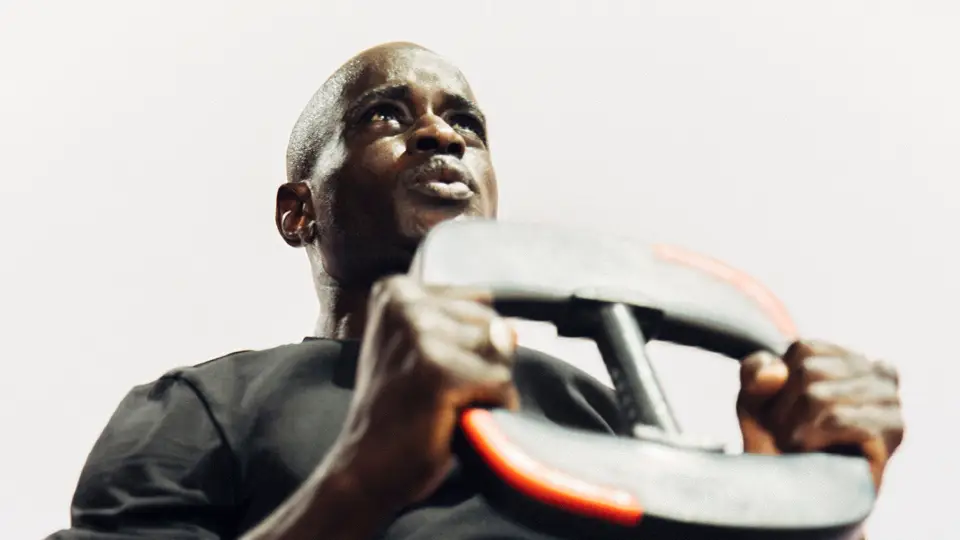
Grip strength could soon be considered a new vital sign if some researchers have their way. According to a large-scale study (involving over 500,000 participants), low grip strength is linked to a higher risk of all-cause mortality with a specific increased risk of cardiovascular disease, respiratory illness and cancer. The researchers found that for every 5kg decrease in grip strength, mortality risk increased by 16-20%, cardiovascular death risk increased by 19-22% and respiratory disease death risk increased by 24-31%.
How to test grip strength:
Grip strength is most commonly measured using a hand dynamometer (which assesses the force exerted when you squeeze and indicates muscle strength in the upper body). You hold the dynamometer in one hand and squeeze as hard as possible for 3-5 seconds to get a measure. Good grip strength is between 30-48kg for males and between 16-30kgs for females (depending on age)
Don’t have a dynamometer? Try the Towel Twist Test.
- Twist a wet towel as hard as you can for 10–15 seconds.
- Compare how long you can maintain the twist or how much water you can wring out.
Why we love this test:
Muscle strength declines with age, and grip strength is a reliable proxy for overall muscular health.
How to improve grip strength:
Deadlifts, farmer's carries or hanging from a pull-up bar are all great ways to increase grip strength. Weight-based workouts like BODYPUMP™ and LES MILLS STRENGTH DEVELOPMENT™ provide full-body strength training and also help increase grip strength.
Test #4: Push-up test
The number of push-ups you can power through without stopping could say a lot about your cardiovascular health and longevity. A 10-year study of 1104 firefighters has indicated that aiming for 40 push-ups in a row could be the way to go. Men who could complete 40 or more push-ups had a 96% lower risk of developing cardiovascular disease compared to those who could do 10 or fewer.
How to test push-up capacity:
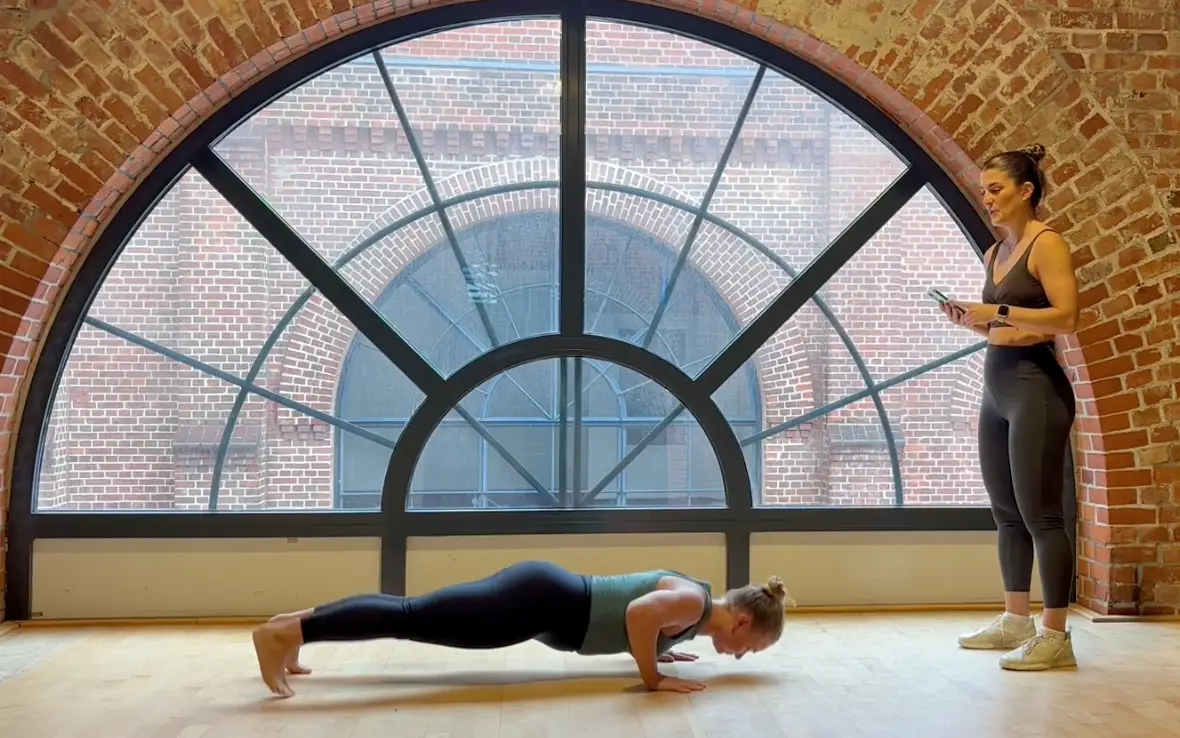
- Start in standard push-up position; hands shoulder-width apart, body straight from head to heels. Lower your body until your chest nearly touches the ground. Push back up to the starting position.
- Repeat without pausing, ensuring good form for every rep (no sagging hips or flared elbows).
- Reaching 40+ push-ups can be an indicator of excellent cardiovascular endurance, 20-39 push-ups is good, below 20 may indicate the need to improve.
Why we love this test
With a focus on upper body strength push-ups build muscular endurance and create lean muscle mass that improves overall fitness and good health. Measuring push-up capacity is a no-cost, fast, and simple way to gather insight into functional capacity and cardiovascular disease risk.
How to improve push-up capacity:
Once again, practice is the way to go. If you can't manage push-ups on your toes, don't be put off. Findings published in the Journal of Applied Biomechanics have shown that both the toe and knee variations of the push-up are worthwhile. You can try this 16-day push-up challenge and progress from knee to toe push-ups in no time.
Workouts like BODYPUMP, LES MILLS STRENGTH DEVELOPMENT and LES MILLS GRIT™ provide great opportunities to practice your push-ups, and workouts like BODYATTACK™, BODYCOMBAT™, and BODYSTEP™ regularly feature push-ups too.
Find out more about the science of push-ups.
Test #5 Flexibility test
Extending your life potential could come down to your ability to touch your toes. Scandinavian researchers have found a fascinating link between greater flexibility and lower mortality rates. Women who scored highly for flexibility were five times less likely to suffer premature death, and men were twice as likely to live longer.
How to test flexibility:
While the Flexindex is commonly used to test flexibility across 20 different joints, the self-sit and reach test is the easiest option to do solo at home.
- Sit on the floor with your legs together in front of you and ankles flexed, put your palms on top of each other, and reach forward a couple of times before reaching forward as far as you can, holding for three seconds.
- Record how far your hands go (to your knees, mid-shin, ankle, or past your toes).
How to improve flexibility:
Regular stretching (specifically PNF stretching), yoga and classes like BODYBALANCE will help build your flexibility. Strength training is also important, as strengthening muscles can improve flexibility by supporting better joint mobility and balance.
Check out LES MILLS+: The Athletic Series Mini Challenges have been expertly shaped to drive athletic and mobility gains in just four weeks. Choose to improve jump power, improve flexibility, or improve strength endurance.
START NOW
FIT PLANET SIGN UP
Sign up to Fit Planet and get fresh health and fitness news and advice straight to your inbox.
FIT PLANET SIGN UP

Fit Planet
Exercise for mental health: What the research says about feeling happier, healthier, and more resilient
Fit Planet
How to become a group fitness Instructor: A step-by-step guide
Fit Planet
Why music makes exercise feel easier, more enjoyable, and more effective
Fit Planet
Are you eating enough to support your workouts? 7 signs you're under-fueling your training
Fit Planet
10 signs you'd make a great group fitness Instructor
Fit Planet
Does exercise help you lose weight? What the science really says
Fit Planet
How much strength training do you need to live longer? Scientists say 90-120 minutes per week
Fit Planet
Should you change your workouts based on your menstrual cycle?
Fit Planet
When is the best time to exercise? Morning vs evening workouts explained
Fit Planet
What is CEREMONY HYROX? A complete guide to the new Les Mills x HYROX workouts
Fit Planet