The simple gym design principle that powers profitability

Research shows today's members seek connection, confidence, variety and belonging in an environment where they can work out how and when they want. It sounds like a lot to deliver, but the most profitable clubs use a secret weapon to simplify their approach.
These clubs combine modern member expectations with a systematic approach to space optimization that drives stronger retention, higher engagement and greater long-term profitability.
By understanding the contribution of every square metre and designing spaces around what modern members value most, operators can unlock significant growth opportunities.
The Formula for High-Performing Gym Space
The contribution of any fitness space can be measured using three key factors:
Contribution = Capacity × Utility × Flow Rate
Capacity
How many people can comfortably use the space.
Utility
How often the space is used throughout the day.
Flow Rate
How frequently users can move through the space.
This formula helps operators assess whether every area of the club is working as hard as it could be. Fitness Economist Gerry Salmon’s extensive research into club design highlights the significant variance in capacity across different gym zones. He notes: “Different activities require different amounts of space. For example, CrossFit style training needs roughly ten square meters/107 feet per person. A gym floor requires 6m/65ft² per person, cardio is 5m/53ft². Group training is positioned well in this space – it can create really high capacity in a studio, which is very attractive.”
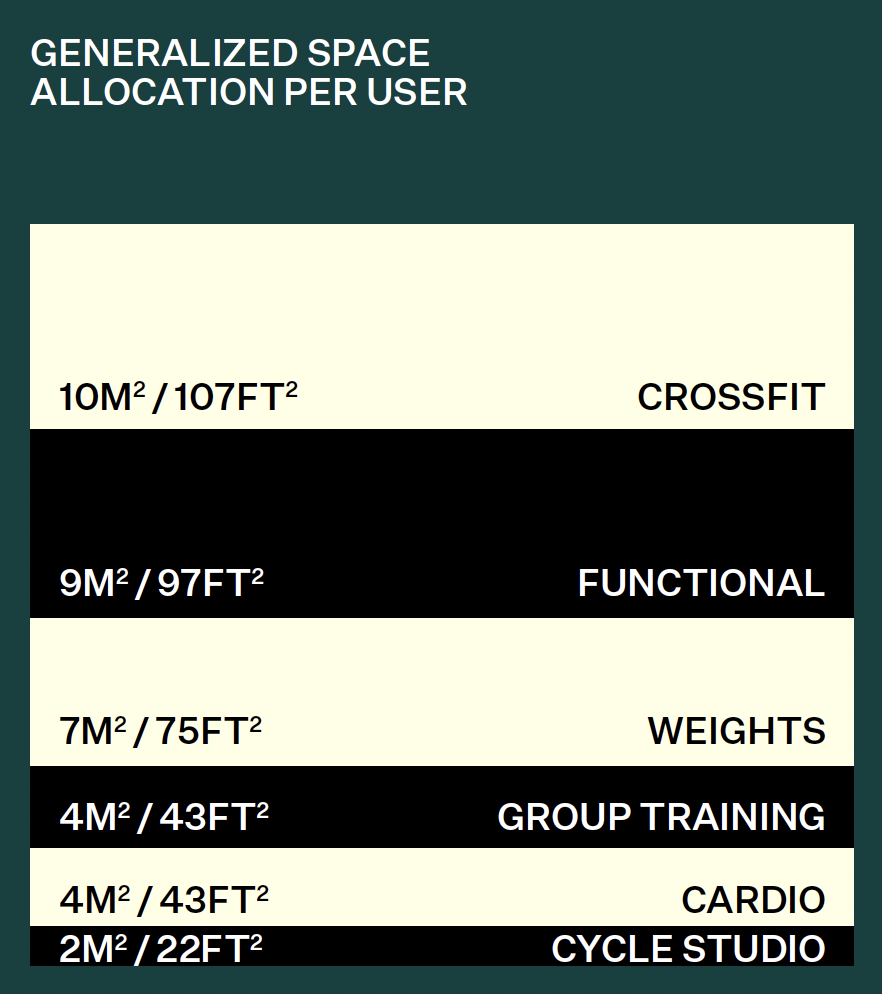
Each activity comes with different utility rates, flow dynamics, and capital/operating costs, which vary depending on the dynamics of your club. But when it comes to maximizing these elements, group training is a game-changer, says Gerry: “Not only is there high capacity in group training – roughly 4m² or 43ft² per person – but it’s high utility as well.”
“That means that a lot of people fit in that space comfortably and they love being there, so it draws lots of people into that space. Beyond utility, contribution is determined by capacity and flow rate – that's how quickly the studio can turn over for a new group of members, especially during peak times.”
But perhaps more importantly, the studio delivers what modern consumers increasingly want: Connection, guidance and belonging.
Why Contribution Margins Matter
Identifying the contribution margins of each area of your club is the foundation of sustainable growth. It’s a yardstick for measuring true operational efficiency – and highlighting where there’s room for improvement. The stronger your contribution margin, the greater your capacity to reinvest in your product through innovation and other club growth drivers.
Contribution margins reveal:
- Which spaces generate the strongest return
- Where capacity is being underutilized
- Opportunities to improve member experience
- Areas that support long-term retention
As Gerry explains, operators should be asking one core question:
"How do I maximize the return from every square metre or square foot? When you look at the layout of a club, assess how much you’re dedicating to an exercise space, and how much income that space will generate. Once you've done that, you look inside those exercise spaces and consider how they’re divided up, to ensure maximal contribution to the club.”

Why the Most Valuable Floor Space Builds Community
The most profitable area in your club isn't necessarily the one containing the most equipment. It's the one that services the most members and compels them to return.
Recent consumer research from ABC Fitness shows:
- 57% of active consumers agree that fitness community significantly impacts their long-term commitment to an active lifestyle
- Gym check-ins are up 27% year-over-year
- At the same time, membership cancellations have increased by 8% year-over-year
The message is clear: members who find their community engage deeply. Those who don't are increasingly likely to leave. This creates a critical challenge for operators:
Does your floor plan simply accommodate exercise, or does it help people belong?
Every area of the club plays an important role in the member experience, but contribution margin helps operators determine how much space should be allocated to each. Group training studios are uniquely positioned to solve this challenge. They provide a ready-made environment for members to connect with others, build routines, celebrate progress and develop meaningful relationships around shared goals. This addresses the member need element. But group training is also uniquely positioned to help your club operate better. It empowers you to maximise your flow rate, increasing the turnover of members you can support throughout the day. The structured nature of the workouts keeps participants moving efficiently toward their goals, prevents individuals from monopolizing equipment, and ensures smooth, timely changeovers – all under the guidance of expert Instructors.
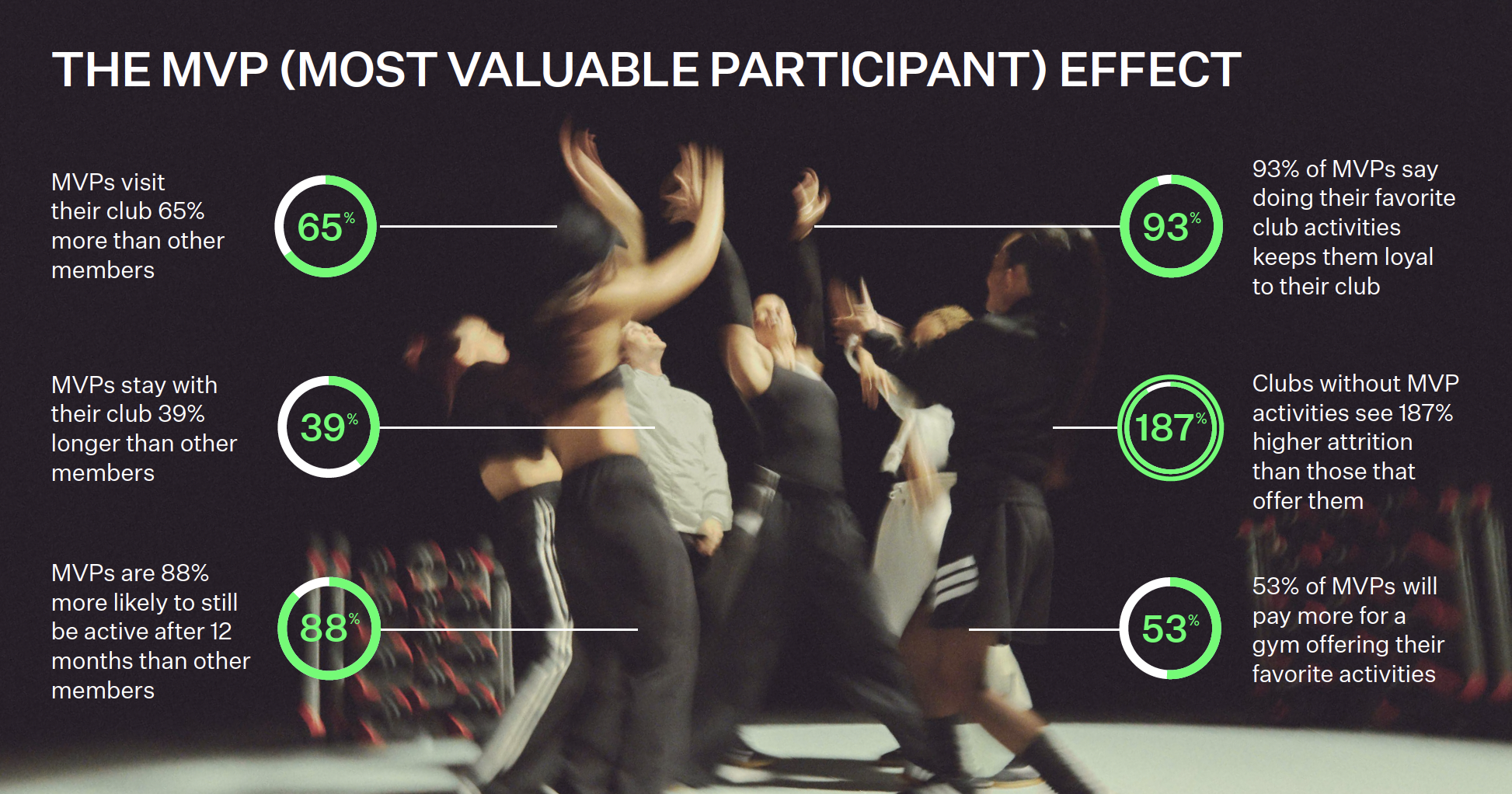
The result is not simply a better workout experience, it's stronger retention – as demonstrated by research from 4Global and ROR Partners showing that members who do Les Mills workouts are a club’s Most Valuable Participants (MVPs). MVPs attend their club more often, stay longer, and have a higher lifetime value (LTV) than any other member category – all testament to the power of belonging for driving club growth.
Busy Gyms Can Discourage Attendance
• 20% of members say their gym is too busy, preventing them from attending more often
Solution: Well-programmed studios help distribute traffic more effectively, reducing congestion across the gym floor while creating additional opportunities for participation. An example would be steering members seeking strength training into your strength classes, enabling you to accommodate more of them at the same time and reduce bottlenecks on the busy gym floor.
Additionally, members who supplement individual training with group workouts benefit from expert coaching and form correction that enhances their performance beyond the studio. By helping members get better results wherever they train, the group exercise experience reinforces its value, creating momentum that strengthens both loyalty and outcomes.
Shortening some of your live classes can also be an effective way to create additional timetable flexibility. Nervous members can ease themselves into the live environment, time-poor existing members get a high-level, coached workout in the time they have available, and operators extract maximum value from their studios.
Gerry Salmon explains: “I’ve seen mistakes happening in that space, a lot of workouts were longer than they needed to be, when in actual fact, if you ask your consumer, they'd prefer something quicker – 45- or 30-minute classes in some cases.
“HIIT classes are great for this because members love getting the job done and hitting all the markers at once. And for format economics, it’s gold. So I think some of those learnings we're now starting to grasp in the design of our clubs going forward, and how we can gain the greatest contribution from every square meter, which is so important.”

The Untapped Opportunity Right Outside Your Club
Optimizing floor space is key but given the breadth of choice available to modern exercisers, it’s unsurprising to learn that they’re already making decisions about your club before they’ve even stepped foot in it. The upsurge in activities like running, walking and at-home digital workouts means there’s more choice than ever – and research suggests there’s a growing community of active non-members who, with the right approach, can be converted into loyal club fans.
Research shows:
- 63% of active non-members prefer fitness opportunities within one mile of home (ABC Wellness)
This presents a significant opportunity for local acquisition. Waiting for prospects to walk through the door won’t win this crowd over, but for clubs willing to engage communities where they already gather, growth awaits. A “stealth marketing" approach that takes workouts or run clubs outside to local leisure spots enables operators to connect with people who are already active, build relationships, and introduce them to the community waiting inside the club. Locations to consider include:
- Local parks
- Running trails
- Community events
- Coffee shops
- Social fitness meet ups
FAQs
What is the most profitable area of a gym?
The most profitable area is typically the space that maximizes capacity, utilization and flow rate while supporting member retention. Group training studios often perform strongly because they can accommodate more members, increase engagement and foster community.
How can I measure the contribution of my facility?
The contribution of any fitness space can be assessed using three key factors:
Contribution = Capacity × Utility × Flow Rate
Capacity: How many people can comfortably use the space at one time.
Utility: How often the space is used throughout the day.
Flow Rate: How frequently users can move through the space, allowing more people to benefit from it over time.
A space delivers greater contribution when it accommodates more users, remains active for more of the day, and enables a higher throughput of participants. By evaluating each of these factors, operators can identify opportunities to increase the value and performance of their fitness spaces.
What do Gen Z members want from a gym?
Gen Z increasingly values social connection, variety and community. Many view the gym as both a place to exercise and a place to build meaningful relationships.
DISCOVER IDEAS DESIGNED TO GROW YOUR CLUB
Find more ideas to move your club forward in the Les Mills Insight Hub.
DISCOVER IDEAS DESIGNED TO GROW YOUR CLUB

Clubs
The simple gym design principle that powers profitability

Clubs
What are the Best Group Training Classes to Attract New Gym Members?

Clubs
5 best practices for building lasting member loyalty

Clubs
Waarom groepsfitness een belangrijke factor is voor ledenbehoud bij sportscholen en fitnessclubs

Clubs
Video: How Nuffield Health increased group fitness attendance by 20% with LES MILLS REFORMER

Clubs
Waarom community de sleutel is tot groei van fitnessclubs

Clubs
LES MILLS REFORMER™: zo spelen fitnessclubs in op de groeiende Pilates-markt

Clubs
The music-led Reformer experience turning boutique fans into big box converts

Clubs
Nieuwe leden binnenhalen is één ding, ze behouden is de echte uitdaging

Clubs
Wat vertellen de cijfers écht over jouw fitnessclub?

Clubs
Generatie Z als groeimotor: 5 manieren om jonge leden aan je club te binden

Clubs