Why music makes exercise feel easier, more enjoyable, and more effective

Music can make exercise feel easier, more enjoyable, and more effective. Research shows that the right workout music can boost motivation, improve endurance, reduce perceived exertion, and even help your brain process exercise differently. It motivates us, helps us maintain or increase our pace, lifts our spirits, encourages rhythmic movement, and distracts us from pain and fatigue. Music is the soul of every great workout. So what happens in our brains when the beat drops?
Why music helps workout performance
As a leading expert on the relationship between music and exercise, Professor Costas Karageorghis, author of Applying Music in Exercise and Sport, describes the right workout music as a type of "legal performance-enhancing drug."
Ethiopian athlete Haile Gebrselassie would likely agree. In 1998, he broke the indoor 2,000-meter world record and later credited part of his pacing success to synchronizing his stride with the beat of Scatman by Scatman John.
Scientists widely agree that music can help people exercise faster and harder, while also making exercise feel easier and more enjoyable.
Karageorghis' research has shown that synchronous music, music that matches the tempo of movement, can:
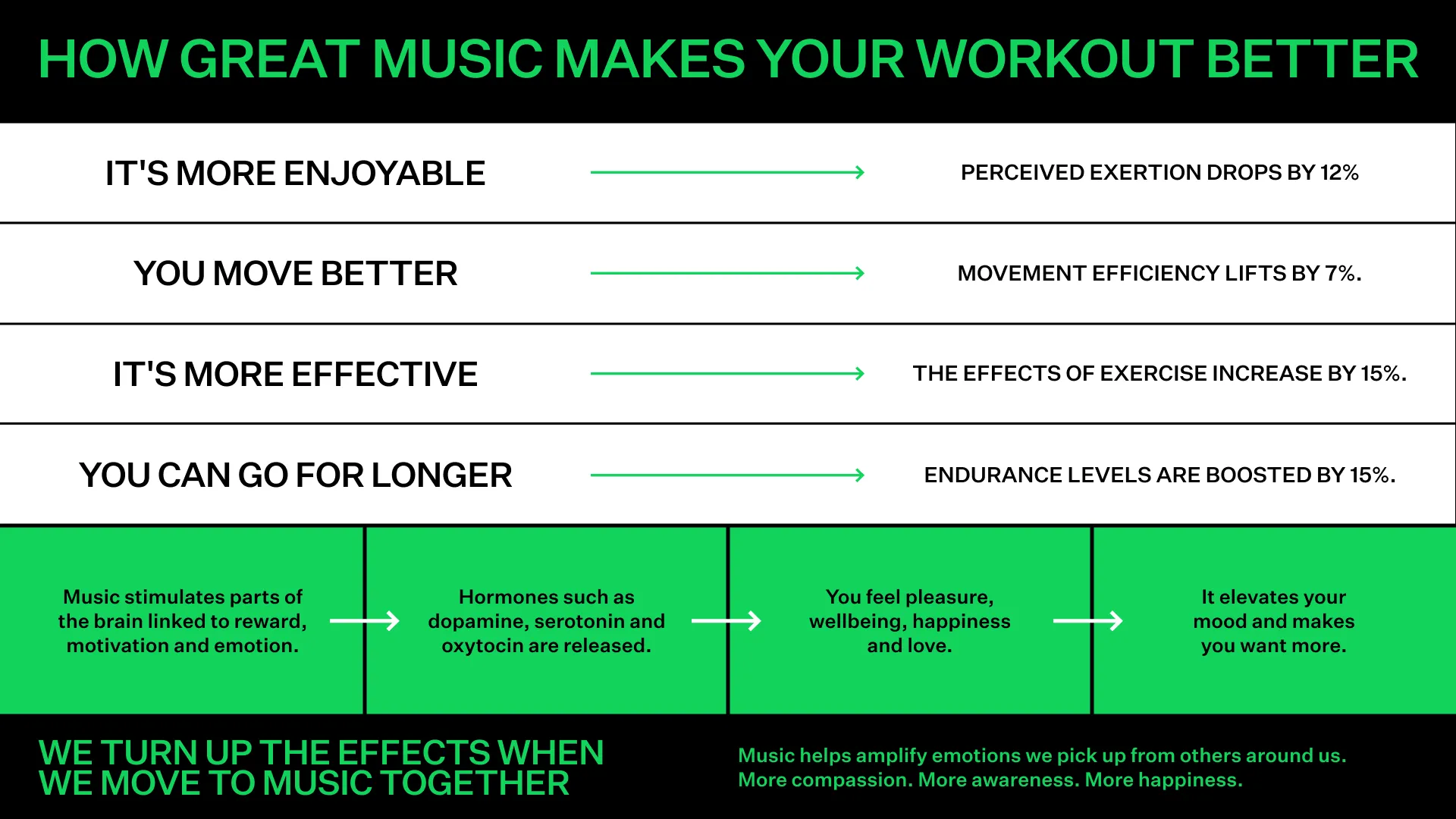
• Reduce perceived exertion by up to 12%
• Improve exercise performance by up to 15%
• Increase endurance by up to 15%
• Improve movement efficiency by approximately 7%
When music aligns with movement, it can create a powerful connection between body and mind that enhances both enjoyment and results.
What happens in your brain when you exercise with music?
Listening to music activates brain regions linked to movement, reward, motivation, emotion, and memory, helping exercise feel more rewarding and less difficult.
Scientists have long known that there are direct connections between auditory and motor neurons in the brain. Even when someone is sitting still, listening to music they enjoy increases activity in areas associated with movement coordination. Some researchers suggest that our instinctive desire to move in time with music is the result of this neural "crosstalk".
According to UK scientist Dr. Bryony L. Ross, music stimulates both the hypothalamus, which influences hormone release and emotion, and the brainstem, which helps regulate heart rate, blood pressure, body temperature, and muscle tension.
Brain imaging studies show that when we hear music we enjoy, areas associated with reward and motivation become more active. Hormones such as dopamine, serotonin, and oxytocin are released, helping us experience pleasure, wellbeing, happiness, and connection.
In contrast, music associated with negative experiences can trigger stress responses and elevate cortisol levels, reducing enjoyment and motivation.

How music changes the way exercise feels
Dr. Marcelo Bigliassi from the University of São Paulo has spent more than a decade researching how exercise and music influence neural activity and behavior.
His research suggests that combining music and exercise can alter the brain's electrical activity, creating more positive emotional states and increasing dissociative thinking, such as daydreaming. This matters because dissociation can temporarily shift attention away from fatigue and discomfort.
Bigliassi's studies also show increased activation in the left inferior frontal gyrus when music and exercise are combined. This brain region plays a role in processing feelings of exertion, and greater activation appears to reduce awareness of negative bodily sensations during exercise.
Music may even reduce some of the neural signals sent from the brain to working muscles, effectively helping block uncomfortable sensations from entering conscious awareness.
The result? Exercise often feels easier than it otherwise would.
Why music affects people differently
The psychological and physiological effects of music vary from person to person.
Research suggests people who are new to an activity may benefit more from music than highly experienced exercisers. Personality may also play a role. Some studies indicate that extroverts, who typically seek more external stimulation, can be more responsive to music than introverts. Research has explored these differences and how music interacts with exercise experience and personality traits.
Exercise type matters too.
Music tends to work best during repetitive, rhythmic, and physically demanding activities such as:
• running
• cycling
• group fitness
• circuit training
• weight training
• stretching and mobility work
Activities requiring intense concentration may benefit less from musical distraction.
As Bigliassi notes, factors such as exercise intensity, complexity, attentional style, and workout environment all influence how effective music will be.
Why moving to music feels even better in a group
Music influences more than individual performance.
When people move together in rhythm, they become more aware of each other and often feel a stronger sense of social connection. Researchers refer to this shared experience as part of the "group effect."
Studies show that synchronized movement can increase feelings of enjoyment and satisfaction among participants.
Music also amplifies the emotions we perceive in people around us. Research from the University of London found that happy music made happy faces appear even happier, while sad music intensified perceptions of sadness.
This emotional amplification helps explain why group fitness experiences can feel so energizing and memorable.

The Kama Muta effect: why some songs give you goosebumps
That unique blend of positive emotion, physical exhilaration, and social connection created by music has its own name: Kama Muta.
Meaning "moved by love" in Sanskrit, Kama Muta describes the sudden feeling of connection or oneness that can occur when a piece of music deeply resonates with us.
Researchers have observed this phenomenon across cultures, ages, and backgrounds.
Music has a remarkable ability to transcend differences and create shared emotional experiences, making it a powerful force in both exercise and everyday life.
What makes good workout music?
Finding the right workout music is both an art and a science.
Research suggests that matching music tempo to exercise intensity can improve performance and enjoyment.
Professor Peter Terry highlights the importance of selecting music based on desired training outcomes in his paper Psychophysical Effects of Music in Sport and Exercise.
For example, if the goal of a warm-up is to raise heart rate to around 110 beats per minute, music between 100 and 120 BPM may be ideal. Even better is a playlist that gradually progresses from resting heart rate levels of around 70 BPM toward 120 BPM.
Beyond tempo, personal preference matters enormously.
One person's motivational anthem is another person's reason to skip the next track.
The most effective workout music combines:
• a rhythm that suits the activity
• appropriate energy levels
• emotional connection
• personal enjoyment
When those factors align, music becomes far more than background noise. It becomes a training partner.
Final thoughts
Music captures our attention, lifts our mood, encourages movement, distracts us from fatigue, and strengthens social connection.
The science is increasingly clear: music doesn't simply accompany exercise, it actively shapes the experience.
Whether you're running a marathon, lifting weights, cycling, or taking a group fitness class, the right soundtrack can help exercise feel more rewarding, more engaging, and, perhaps surprisingly, a little easier too.
The article includes input from Margo White and Dr. Bryony L Ross.
More about the author
Emma Hogan
Emma is a health and fitness writer with 20 years of experience creating evidence-based features that bridge the gap between scientific research and real-world application. Based in New Zealand, she works with global exercise scientists, physiotherapists, and internationally recognized fitness experts to uncover the latest insights in health, fitness, and human performance.
Known for making complex topics accessible and engaging, Emma writes on everything from strength training and recovery to motivation, behavior change, and lifelong wellbeing. Her work helps readers navigate an increasingly crowded health landscape and make informed choices grounded in credible research rather than trends or misinformation.