How do you know your timetable is working?

Key takeaways: A high-performing timetable does more than fill studios. The most successful timetables increase member visit frequency, improve retention, attract different member segments, and drive referrals. Beyond simply measuring attendance, clubs can evaluate their programming strategies for timetables using metrics such as occupancy, attendance trends, class penetration, retention rates, and member lifetime value.
Most clubs can tell you which classes on their timetable are full. Far fewer can tell you whether those classes are actually driving retention, increasing visit frequency, attracting new participants, or growing member lifetime value.
A packed studio looks impressive. But if attendance isn't translating into long-term member engagement, your timetable may not be performing as well as it appears.
So how do you know if your timetable is working?
The answer lies in looking beyond occupancy and understanding the behaviors that indicate long-term success.
A successful timetable:
- Increases member visit frequency
- Supports retention
- Attracts diverse member groups
- Maximizes Instructor impact
- Generates commercial value
What does a successful timetable actually look like?
To maximize the value of your studio space, it's essential to benchmark performance to understand whether your timetable is meeting member needs and supporting business goals. By regularly assessing the metrics that matter the most, clubs can identify what's working, uncover gaps in the schedule, and make more informed programming decisions.
High-performing operators don't just aim to fill classes, they build timetables that create consistent member demand and make group training a core part of the member experience. As a guide, leading club operators aim to offer classes (Live + Virtual) for 60 to 80% of their total opening hours.
The difference between a busy class and a successful class can be as simple as understanding why it’s full. Are members choosing it because it's their preferred workout, or because there aren't enough alternative options to meet demand? Relying on a single popular option can eventually lead to member fatigue. But giving people more choice keeps their experience fresh and offers more reasons to stay – the ultimate measures of timetable effectiveness.
Which metrics should clubs track?
Five timetable KPIs every operator should track monthly

Is your timetable helping members build lasting habits?
Long-term engagement begins with onboarding that helps members understand their options and build routines that fit their lifestyle.
Diving into what motivates your members to show up is key to their success – and your chances of keeping them. This means understanding why new members have chosen to join, why existing members are reassessing their goals, and barriers that could prevent them from succeeding. A quarter of all members say they are too busy to find the time to visit their club more regularly – a clear sign that understanding existing routines and the time members have available helps hatch a plan they can adhere to.
The relationship between habit formation and retention is underpinned by the confidence a member feels when they’re in your club. This is where your timetable helps you win. Introducing new members to the motivational expertise of rockstar Instructors supports the 41% of consumers who consider working out to be a chore, and empowers the 25% of consumers who worry about doing things incorrectly to gain foundational knowledge that supports safer training (2026 Global Fitness Report).
Your group training programming strategy should also be designed to support the needs of members who are coming to your club for entirely different reasons. 64% of consumers want to work out where there’s a great vibe, 62% of younger members want workouts that push them to their limits and 54% of all consumers are looking for new ways to get fit (2026 Global Fitness Report). That’s where a broad timetable that balances challenge, community and variety can help turn interest into long-term engagement.
Is your timetable serving the members you want to grow?
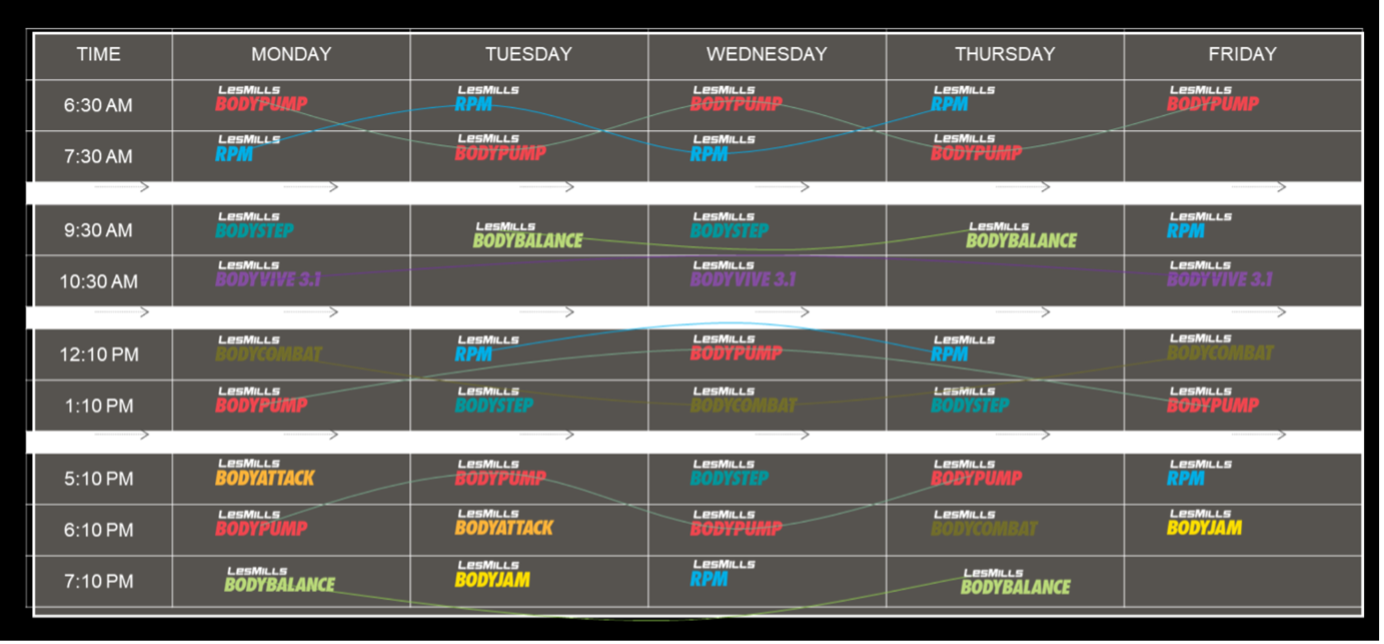
Different audiences need different solutions, but crucially, all audiences need a timetable that works around their busy lives. Analyzing your timetable day by day is important, but scheduling horizontally, instead of vertically, is where you win. Horizontal timetabling – as demonstrated by the example below – allows you to be flexible with your timeslots, broadening the scope of who they attract.
If you’re scheduling strength workouts at the same time every evening, you could be missing out on large numbers of members who will never make that slot, or others who can only make that slot but would attend more classes if they had varied options. To overcome this challenge, try offering each core program at least two or three times a week within a one- to two-hour timeframe.
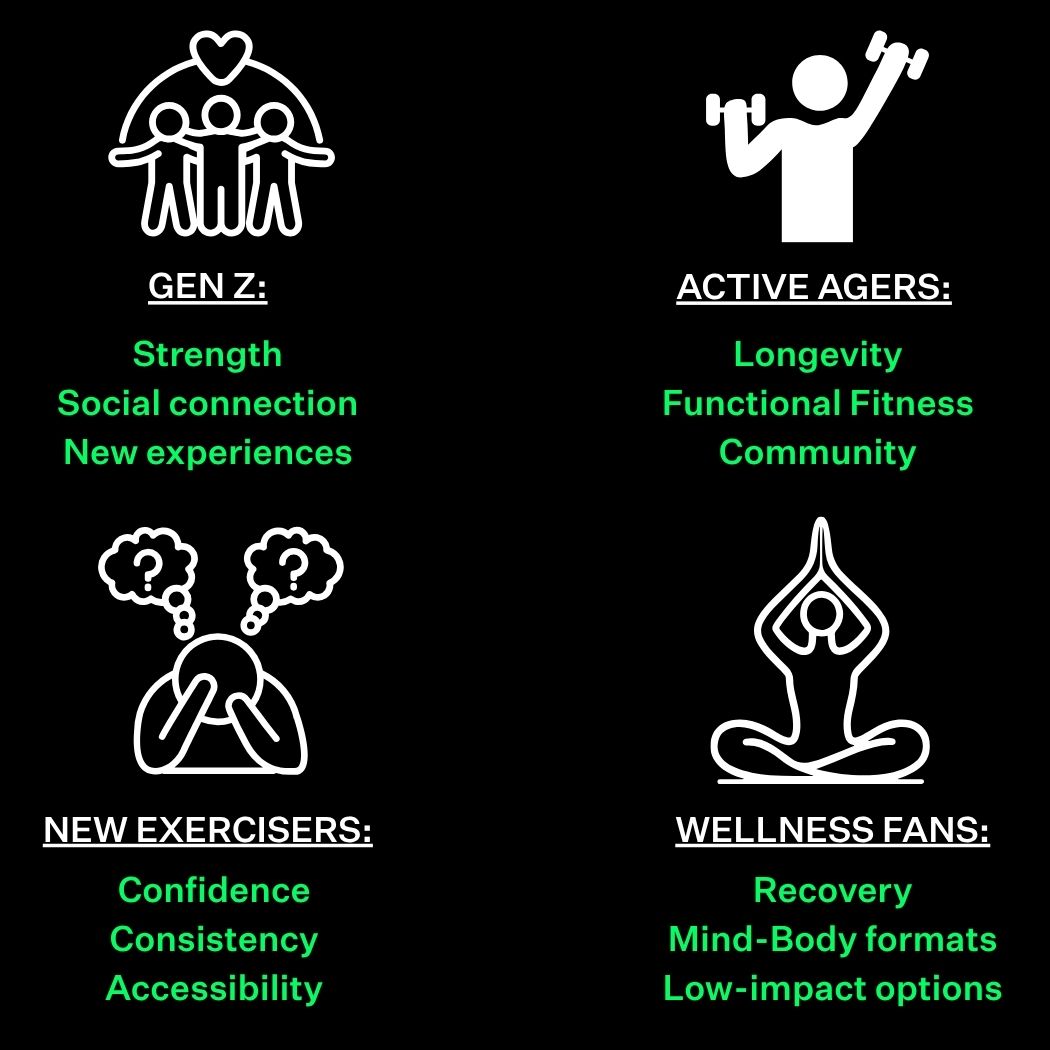
The key needs of your member demographics
A successful timetable serves the needs of all members, but it’s important to recognize the distinct needs of each audience, making it easier to deliver experiences that drive participation and loyalty.
Are the right Instructors teaching the right classes?
Member confidence and connection, habits, FOMO and an environment that drives results all hinge on the perfect Instructor. The atmosphere they create can make or break the success of a class on your timetable, determining members’ motivation to return and the all-important results that help them understand the impact classes are having.
It’s why matching Instructors with your target audience is a critical part of timetable optimization. Fitness leader and gym owner Mel Tempest has spent decades recruiting Instructors, and believes assigning classes goes beyond the qualification. “Sometimes you know someone will be a good Instructor, but the right program matters,” she says. “It’s important to join the dots with what people are doing outside of your club, to harness their experience inside it. For example, my club manager, who has trained in CEREMONY HYROX, has just started doing HYROX, and she's close to the exercises and workout style. So obviously it was a great opportunity for us and for her.”

Of course, Instructors don’t exist in a vacuum, being just as likely to seek out dynamic fitness experiences as your members. When your timetable feels fresh, relevant, and aligned to current trends, it doesn’t just drive participation; it builds momentum. That energy creates a natural pull for Instructors too, attracting people who want to be part of something current and in demand. In turn, the right experiences don’t just fill classes; they help build the Instructor pipeline behind them.
At the University of Iowa, a switch-up in programming and increased student advocacy for group training sparked record Instructor recruitment and soaring member engagement.
Jamie Poch, Assistant Director of Fitness, Group Fitness, says: “Introducing the Les Mills Innovation Collection has been a game changer. LES MILLS STRENGTH DEVELOPMENT™ initially resonated most with our 35+ demographic, but is now attracting more student participants, thanks in part to younger Instructors who recently became certified and serve as university personal trainers. Their presence on the gym floor and in the studio sparks both familiarity and intrigue, encouraging members to explore everything on offer.”
What are the warning signs that your timetable isn't working?

And how can you fix the problem?
Making the studio a staple of your members’ training requires sufficient variety to suit their tastes. In an age of unprecedented choice, modern members want to do it all. Les Mills Group Fitness Management (GFM) – the seminal training experience for ensuring studio success – recommends 8 unique class formats on your group training schedule to ensure adequate breadth of choice to meet demand and support your studio goals.
But of course, each operator knows their members best, so the trick is to take this guidance and then pay close attention to class attendance stats to refine the timetable to suit your club’s specific member profile. The graphic below illustrates the benefits of each genre and how these meet the needs of certain personality types across your membership. This can be used to support identification of gaps and overlaps on the timetable.

MVPs and where to find them
A broad timetable that spans genres, time slots and meets member demand is crucial. But so is the quality of your programming. Research from fitness data consultants 4GLOBAL and ROR Partners examined 2.6 million member journeys across 1,312 leading clubs in the US and Europe. They identified the behaviors that determine a club’s MVPs – Most Valuable Participants – whose higher visit frequency, stronger loyalty and longer tenure increase lifetime value.
The data found that members who attend Les Mills group fitness classes visit their facility 65% more than other members, stay 39% longer than other members, are 88% more likely to still be active after 12 months and have a 27% higher lifetime value (LTV) than other members – not including the higher number of member referrals MVPs typically contribute.
Furthermore, clubs offering Les Mills workouts see a 65% lower% attrition rate than those that don’t offer them. Group training participants – and specifically, Les Mills group training participants – are among the most valuable type of member you can have.
Put simply, the most effective timetables combine the right schedule with the right offering.
Five questions every club should be asking about its timetable
- Which classes create the highest repeat attendance?
- Which classes attract new participants?
- Which formats drive the longest member retention?
- Which Instructors generate the strongest engagement?
- Which member groups are underserved?
The answers reveal what's driving participation, loyalty and growth, helping you build a timetable that works harder for both members and the business.
DISCOVER IDEAS DESIGNED TO GROW YOUR CLUB
Find more ideas to move your club forward in the Les Mills Insight Hub
DISCOVER IDEAS DESIGNED TO GROW YOUR CLUB
More about the author
Jo Bryce
Jo is a content specialist focused on the global fitness industry. Her role (as Global B2B Content Manager) at Les Mills brings the latest fitness and wellness developments to life, translating research, trends and real-world operator experiences into practical strategies that help fitness businesses navigate a rapidly evolving market.
As a writer, Jo has worked across a range of sectors spanning broadcast, technology and fitness, developing content for both consumer and business audiences. She holds a Master's degree in English Literature and enjoys running and boxing.


Clubs
Four key fitness findings operators need to know in 2026


Clubs
Five things we learned at FIT BUSINESS LIVE BARCELONA

Clubs
The simple gym design principle that powers profitability

Clubs
What are the Best Group Training Classes to Attract New Gym Members?

Clubs
5 best practices for building lasting member loyalty

Clubs
Waarom groepsfitness een belangrijke factor is voor ledenbehoud bij sportscholen en fitnessclubs

Clubs
Video: How Nuffield Health increased group fitness attendance by 20% with LES MILLS REFORMER

Clubs
Waarom community de sleutel is tot groei van fitnessclubs

Clubs
LES MILLS REFORMER™: zo spelen fitnessclubs in op de groeiende Pilates-markt

Clubs
The music-led Reformer experience turning boutique fans into big box converts

Clubs