Foam rolling
.webp)
The popularity of the foam roller has exploded. In recent years these cylindrical pieces of foam have garnered a cult-like following. But is the foam rolling fuss warranted? We’ve looked at the science to see how foam rolling stacks up …
Does foam rolling work?
Despite being twenty or so years since studies began, the science behind foam rolling is still in its infancy. Nevertheless, some useful patterns in the research findings are starting to emerge.
Foam rolling, overall, does not appear to affect athletic performance
Many studies have explored the effect of foam rolling on subsequent athletic performance, yet only one study has ever concluded that foam rolling impedes athletic performance. Every other study has either found no effect or a positive effect on performance. This suggests that, overall, foam rolling before exercise will not hamper performance.
Foam rolling before exercise may well improve short-term flexibility
Many studies have explored the effect foam rolling has on short-term flexibility, concluding that foam rolling before a workout will increase the ROM at the joint the muscle crosses (e.g. foam rolling down the thigh muscles increase ROM at the knee). This suggests that using a foam roller as part of a warm-up routine could be beneficial.
Foam rolling after exercise can help reduce DOMS
All of the studies exploring whether foam rolling after exercise reduces the symptoms of delayed-onset-muscle-soreness (DOMS) have concluded that it does. It has been suggested that 20 minutes of foam rolling at the hips and legs for the three days following a leg training session may decrease DOMS pain. An acute 10-minute foam roll may immediately reduce DOMS pain for up to 30 minutes.
Why does it work?
More research needs to be done to provide conclusive evidence, but there are three prevailing theories as to why foam rolling works:
Theory 1: Both the mechanical pressure and subsequent heat generation cause the fluid at the joint to become runnier, which decreases the resistance that would otherwise be caused by friction. Think of the effect that oil has on a metal joint, it's the same thing.
Theory 2: The direct pressure along the direction of muscular pull slightly re-aligns any collagen fibers from a more random to a more uniform direction, leading to increased lymphatic drainage and less resistance.
Theory 3: The direct pressure onto the muscle shows a typical stretch-response (e.g. when you stretch, the muscle contracts for a few seconds, and then relaxes allowing you to stretch further), meaning that after 15-30 seconds, the muscle relaxes enough to increase the ROM.
THE BOTTOM LINE
The research behind foam rolling suggests that using a foam roller can yield important benefits, whether you use the foam roller before or after your workout. Using the foam roller before training can increase the ROM, which could decrease the chances of injury. Using the foam roller after training can decrease DOMS, which could speed up recovery and make DOMS more manageable. It seems that using the foam roller does not impede performance, meaning that you have nothing to lose by trying it out!
Don’t have a foam roller? Check out the Les Mills Equipment range of wellness accessories. This range, which includes foam rollers, yoga mats and massage balls, has been designed to help you enhance your workouts and improve your results. Shop the full collection.
HOW TO FOAM ROLL EFFECTIVELY
There are several ways that you can use a foam roller depending on which joint or muscle you want to affect, and what type of foam roller you are using.
Here is a quick guide on some of the most popular and effective foam rolling exercises. These exercises target the muscles and joints that tend to be the tightest in most people.
Calf
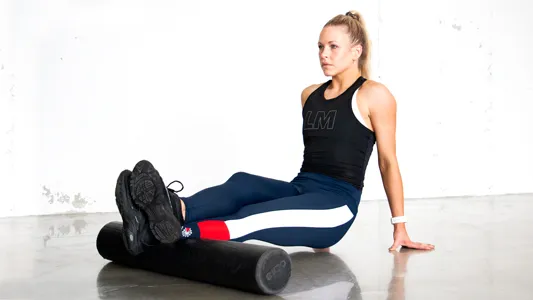
- Sit on the floor with the foam roller underneath the upper part of the ankles.
- Lift your hips off the floor and move your body down towards the roller (so the roller is rolling towards the knee).
- Move so that the roller is about an inch nearer to the knee, and then rock side-to-side for 15-30 seconds. Repeat inch by inch up towards the knee.
- If the pressure isn’t hard enough, try it with one leg only.
Quads
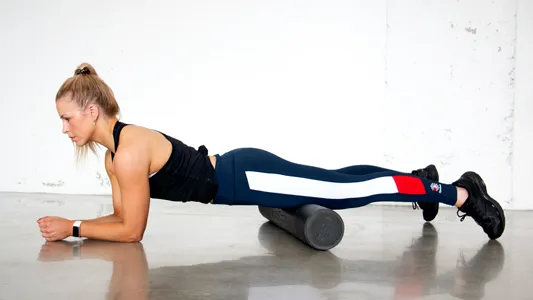
- With the foam roller on the floor, face the floor with the foam roller just above your knees on the quads.
- Move so that the roller is about an inch nearer to the hip, and then rock side to side for 15-30 seconds. Repeat inch by inch up towards the hip.
- If the pressure isn’t hard enough, try lifting one leg up and doing it with one leg at a time.
IT Band
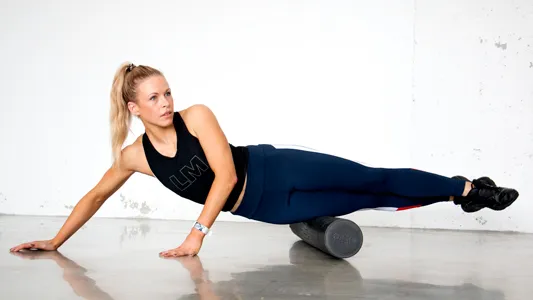
- Lie on your side with the foam roller resting just up from the knee on the side of the leg.
- Move until the roller is about an inch nearer to the hip, and then rock side to side for 15-30 seconds. Repeat inch by inch moving towards the hip.
- If the pressure is too much, put more weight into your arms to decrease the pressure on your leg.
- Repeat with the other leg.
Glutes
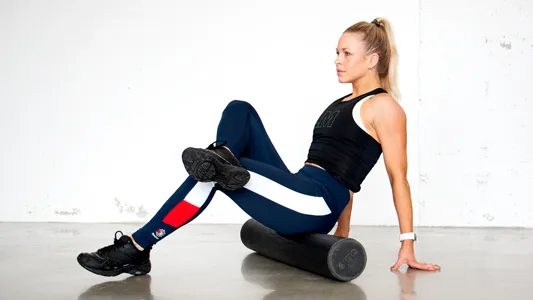
- Sit on the roller so that the roller is underneath the butt.
- Bring one leg across until the ankle rests on the opposite knee/thigh.
- Using your arms for support behind the roller, move the roller up and down and side to side.
- Once you find a particularly tender spot, hold the pressure on that spot for 15-30 seconds.
SEE NEW FOAM ROLLING SESSIONS ON LES MILLS+
Mike Trott is a UK-based fitness professional who specializes in sports personality psychology and sports exercise physiology. He has conducted academic research into group exercise interventions and personality, exercise addiction, and foam rolling physiology, and is also a multi-award-winning Les Mills instructor, trainer and presenter.
Sign up to Fit Planet and get fresh health and fitness news and advice straight to your inbox. Subscribe
Fit Planet
Period power: Should your cycle shape your training?
Fit Planet
Les Mills and Life Fitness announce strategic partnership to elevate fitness experiences

Fit Planet
Working out can create a much bigger impact than you think

Fit Planet
How to unlock your push-up potential (and why it's worthwhile)

Fit Planet
Research roundup: the true power of intensity revealed

Fit Planet
Food trends: What’s set to change about how we fuel our bodies?



Fit Planet
Weight loss jabs: The side effect nobody’s talking about. And how to avoid it
Fit Planet