Fascinating fitness history part 2
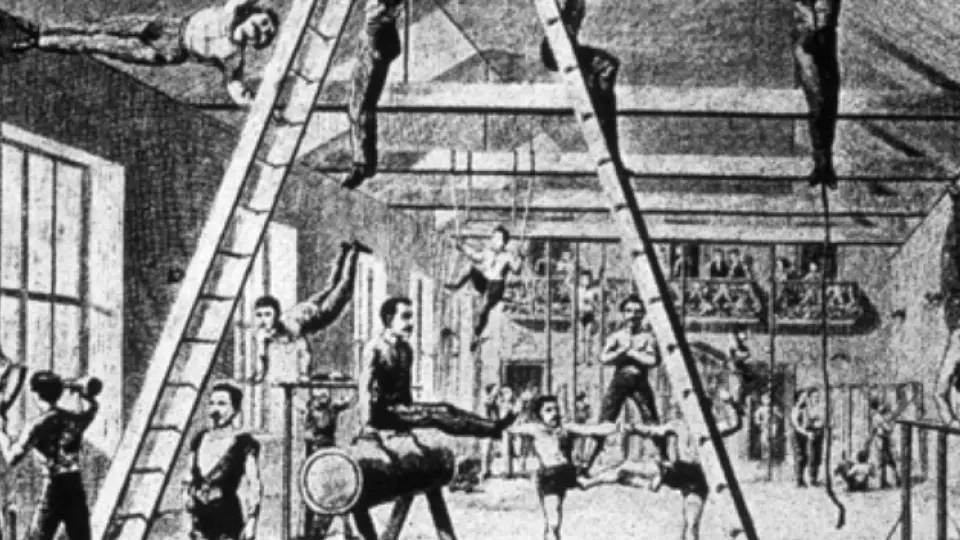
Coming together to lift, squat, pulse, jump, and sweat is hugely motivational – but where did it all begin? Take a deep dive into history and discover how ancient Egyptians, circus strongmen, and Swedish gymnasts shaped the fitness spaces we know today.
No one knows exactly when structured exercise made a formal entry into the lifestyle of humans. The earliest records indicate that around 2,000 B.C (over 4,000 years ago) the Egyptians formally introduced structured acrobatics and fitness training. Egyptian culture saw acrobatics as both entertainment and sport, and its practitioners realized that to excel in this early form of physical performance they had to train appropriately. This led to the introduction of structured fitness regimens involving bodyweight calisthenics. The Egyptians were not the only civilization to realize exercise was important, or as we might say today, exercise is medicine. During this same time period, it is believed the Chinese practised a form of exercise called Cong Fu that used a combination of breathing and formalized fluid movements.
While the Chinese and Egyptians are credited with introducing structured exercise, it wasn’t until the Greeks introduced formalized training for competitive athletes that fitness finally received cultural acceptance. At the peak of Greek civilization, fitness was seen as critical to martial prowess (i.e., fighting), restorative capability (i.e., healing of the body, mind and soul) and educational (introduced into the post-secondary education system). The manner in which the Greek civilization valued exercise is best summed up in two quotes. The first is a quote attributed to the famous Greek physician Hippocrates who lived between 460 and 377 B.C: “If we could give every individual the right amount of nourishment and exercise, not too little, and not too much, we would have found the safest way to health.” The second quote, and equally profound, is from the famous Greek philosopher, Plato who said: “Lack of activity destroys the good condition of every human being, while movement and methodical physical exercise save and preserve it.”
For some reason, once Greek culture lost prominence, so did the pursuit of structured fitness as a part of the human condition. It took nearly 2,000 years for fitness to regain a foothold. In 1569, an Italian, Hieronymus Mercuialis published the book “De Arte Gymnastica Aput Ancientes” in which he described the use of medicine balls, dumbbells, bodyweight movements and other gymnastic-like movements for physical training. This publication seemed to spur the reemergence of formalized fitness training. Approximately 200 years later, a German, John Basedow introduced a curriculum at his school called the Philanthropinium that used movements and training regimes from Greek gymnastics. 20 years after Basedow, Johann Gutsmuth, known as the grandfather of German physical education, authored ‘Gymnastics for Youth: A Practical Guide to Healthful and Amusing Exercise for the Use of Schools’. These two landmark publications and their focus on making fitness part of the educational curriculum for youth catalyzed the re-emergence of fitness as a means of improving one’s physical health.
The pursuit of fitness in a structured setting
While the pursuit of exercise had long been a solitary activity pursued by a select few, it was the introduction of fitness into the curriculum of schools that spelled the beginning of a more socialized and formal approach to delivering fitness to a wider audience. The leaders of fitness at this time understood that for exercise to be more widely adopted, it had to incorporate a social element whereby those who shared in the joys and agonies of physical exercise would be more likely to pursue it on an ongoing basis. Over the course of this section, we will explore some of the milestones that frame the emergence of fitness into the social and cultural fabric of global citizens.
The pioneering settings of physical culture (1700s to 2000)
The Private Gym (1799)
In 1799, Franz Nachtegall of Denmark established what is believed to be the world’s first private gymnastics club – what today we might call a gym or even a CrossFit Box. It is believed that Nachtegall’s private gym offered large-scale group classes using calisthenics, vaulting, wooden dumbbells and weighted medicine balls.
Turn - The Physical Culture Club (1811)
Many historians credit Frederick Ludwig Jahn of Germany as the father of modern gymnastics and the developer of Turn – a physical culture club built around gymnastics and the shared social and patriotic interests of its members. This may well have been the first attempt to offer a tribal fitness experience. Jahn was the creator of the pommel horse, parallel bars, horizontal bars, vaulting blocks and ladder, all of which became essential training accessories along with climbing ropes in his original Turn.
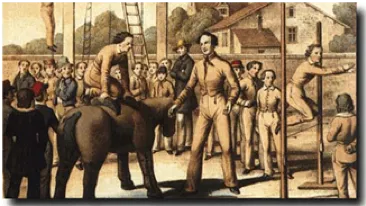
Turn, the physical culture club.
In 1811, Jahn established what is believed to be the first gymnastics club, Public Turn Platz. This was an open field that offered men and boys mass exercise classes that were designed to help them become physically fit to protect their country. Jahn’s initial Turn not only incorporated exercises that employed parallel bars, the pommel horse and horizontal bars, but also integrated dumbbells and Indian Clubs. By 1860 over 150 Turns or Turnverein had spread across the globe, making it the first scaled fitness offering to exist on both sides of the Atlantic.
Swedish Pedagogic Gymnastics – The first medical fitness offering (early 1800s)
Swedish pioneer, Pehr Henrick Ling, frequently referred to as the father of Swedish gymnastics, created Swedish Pedagogic Gymnastics, a systemized approach to gymnastics designed to provide specific medical and health benefits. Ling’s pedagogic gymnastics was founded on four core principles. The first precept was medical, which was grounded in the belief that exercise, through proper posture and movement, could help overcome or diminish certain ailments of the body.
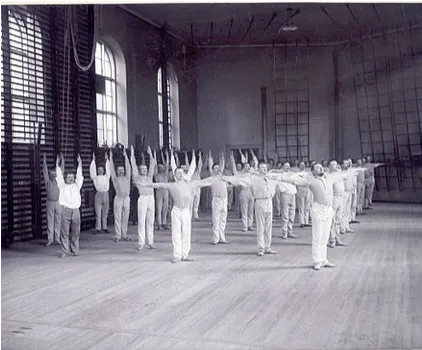
Swedish pedagogic gymnastics.
The second underlying element was military (martial arts), which focused on the role that exercise plays in developing soldiers. Ling’s third principle emphasized the ability of exercise to bring the body under the control of the individual’s will (mind-body). The fourth element was aesthetic, bodily expression to an individual’s internal thoughts and feelings. Over time, Ling’s gymnastics system became the physical training mainstay of the Swedish military. Ling’s approach is also linked to the introduction of massage and osteopathy.
Gymnase Triat – The first membership-driven facility (1848)
Gymnase Triat was the brainchild of Hipplyte Triat. The gym, opened in 1848, was initially located in Brussels, Belgium, but within one year was relocated to its permanent home in Paris, France, where it occupied 9,500 square meters (100,000 square feet). The gym was dedicated to serving every aspect of physical training and included every modern piece of equipment available at the time, including ropes, pommel horses, horizontal bars, Indian Clubs, dumbbells, and globe barbells. Triat’s barbells are believed to be among the first barbells (called Bares A spheres De 6 Kilos) ever offered for use to the public. These barbells were long bars with 6-kilo globe weights attached to their ends. Another ‘first’ associated with the gym was Triat’s approach to financing the club, which involved selling shares in his facility (he sold 250,000 shares at five francs each, raising over one million francs in the process). The individuals who purchased shares in his gym could then redeem those shares for private sessions or for payment of the membership fees.

Gymnase Triat.
The Boston YMCA – The Granddaddy of U.S. fitness facilities (1850)
Shortly after Gymnase Triat opened its doors in Paris, the Boston YMCA introduced the American public to what is believed to be one of the first multipurpose-style fitness gyms in the U.S. (note that Jahn’s Turnverein had opened in Cincinnati in 1848). The Boston YMCA featured many of the same elements of Gymnase Triat, including a fully-equipped gym featuring rings, ropes, pommel horse, benches, wooden dumbbells, ladders, and combat art or martial arts areas.
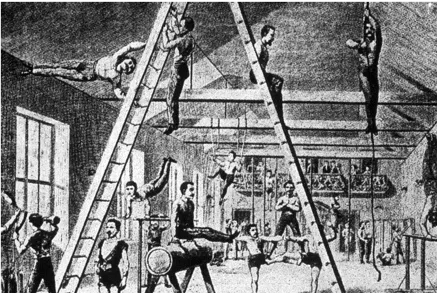
Boston YMCA.
Professor Attila’s Athletic Studios/Schools of Physical Culture - The first personal training gyms in Europe and the U.S.
The forefather of personal trainers, master trainers and strength coaches, as well as a physical culture legend, Leo Durlacher – better known as Professor Attila – appears to be the first fitness professional to build a business model around personal training. Attila established his first personal training gym in Brussels, Belgium, in the 1880s, opened a second gym in London in the late 1880s, and finally founded Atilla’s Athletic Studio and School of Physical Culture in New York, U.S, in 1894. His personal training gyms introduced several modern-day pieces of equipment, including the Globe barbell, the Roman chair, and the Roman column.
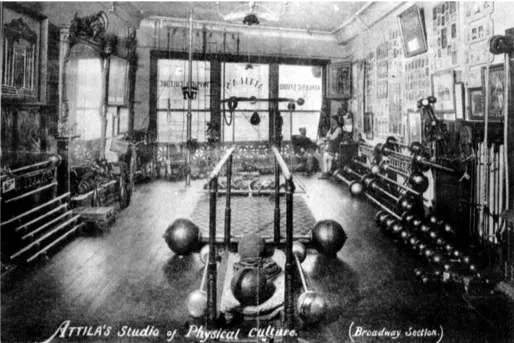
Attila's studio of physical culture.
Professor Attila was one of the first proponents of progressive resistance training for women, and also of using resistance training to combat the effects of aging. Professor Atilla built his reputation by serving as a personal trainer to some of the world’s most prominent athletes and dignitaries of the time, among the most notable being Louis Cyr (a Canadian strongman and onetime world’s strongest man), Gentleman Jim Corbett (one-time heavyweight boxing champion), Eugene Sandow (possibly the most famous strongman of all-time), Cornelius and Alfred Vanderbilt, J.P. Morgan, Jr, John Philip Sousa, Alexander III, Czar of Russia, and King Edward VII of England. In 1926, Professor Attila sold his New York club to Sig Klein, who operated the studio for another 50 years as Sig Klein’s Studio of Physical Culture.
Other notable gyms and clubs of the 1800s
From 1850 to 1900, a number of prominent athletic clubs and gymnasiums opened around the world. Some of these noteworthy facilities include: the New Orleans Athletic Club, New Orleans, LA (1872); the Detroit Athletic Club, Detroit, Michigan (1887); the Hemmingway Gymnasium, Boston, Massachusetts (1888); The Lille Athletic Club, Lille, France operated by Professor Desbonnet (1885), the Wrestling and Weightlifting Club of Saint Petersburg, Saint Petersburg, Russia (1885); the Athletic Club of Florence, Florence, Italy (1880s); and the London YMCA, London, England (1888). These facilities, and many others that opened during the latter half of the Industrial Revolution, all targeted men, with a focus on sports and physical culture using gymnastic style equipment, barbells, dumbbells, medicine balls, ring bells, Indian Clubs, ladders, rings, horizontal bars, etc... These early gyms provided a setting for group calisthenics and incorporated a social element, based on bringing men of like interests together. What we see in each of these early fitness facility offerings is an approach to fitness that is eerily similar to the fitness facilities of the 21st Century.
The pioneering operators of the modern gym experience
Pilates Studio – The first Pilates studio (1926)
Joseph Pilates opened his first fitness studio dedicated to the practice of ‘Contrology’ in 1926. The studio, located in the vicinity of the New York Ballet, originally catered to dancers but later emerged as a popular and effective training modality for circus performers, actors and athletes. The founding studio operated for 50 years and many of today’s Pilates studio chains owe their existence to the original New York studio.

Pilates studio.
Vic Tanny Health Clubs –The first suburban fitness club (1947)
In 1947, Vic Tanny, and his brother, Armand, opened the first chain of modern health clubs. Vic Tanny introduced middle-class America to a new club model, one that pioneered the concept of a facility for men and women (offering alternate day workouts). These clubs offered an experience that was considerably different from the bodybuilding gyms, YMCAs and private athletic clubs that dominated the fitness facility landscape prior to 1947.
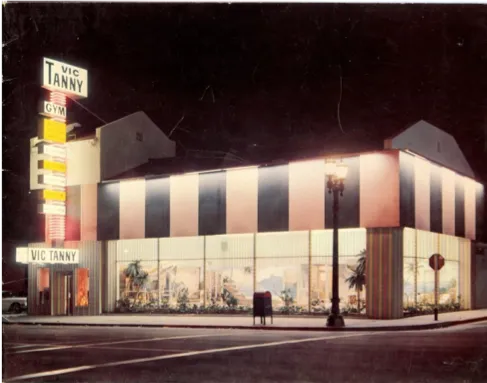
Vic Tanny health club.
Lotte Berk Studio – The first Barre studio (1959)
In the mid-1950s, Lotte Berk, an accomplished German dancer, collaborated with an osteopathic physician to create a series of exercises that were based on her experiences as a dancer. Her exercise techniques combined principles from Pilates and yoga, as well as her own dance background. Berk assigned her exercises obscure names, such as ‘prostitute’, ‘peeing dog’, and ‘French lavatory’.
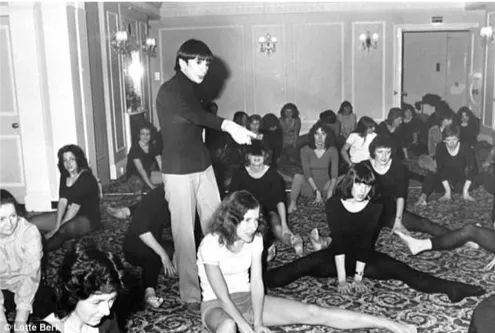
Lotte Berk studio.
In 1959, she opened an exercise studio in Manchester, England, in which she taught her unique and intensive exercise program (focusing on developing the ‘core’). Over the decades, numerous well-known individuals, especially women, flocked to her classes to learn her secrets to developing an incredible core and fantastic legs. Some refer to Lotte Berk as the Queen of Fitness; possibly a more appropriate title would be ‘Queen of Barre’, since today’s various versions of Barre can all be traced back to the Lotte Berk method.
Health and Tennis Corporation (aka Bally Total Fitness) – The first club chain to go public in the U.S. (1962)
Established by former Vic Tanny employee Don Wildman, Health and Tennis took the Vic Tanny business model to an entirely new level. Health and Tennis did not become Bally’s until 1982, and subsequently Bally Total Fitness in 1992. The business model used by Health and Tennis, including its use of long-term membership contracts and hard sales, were right out of the Vic Tanny playbook. The company was an industry pioneer when it came to the acquisition of dominant regional club chains (i.e. Vic Tanny’s, President’s Health and Racquet, European Health Spas, Holiday Universal) to establish a national presence. In time, it became the largest chain of clubs in the world. Bally Total Fitness was also the first club chain in the fitness industry to be purchased by a non-industry firm, and the first fitness club company to be traded on the public markets, although the listing didn’t last very long.
Gold’s Gym – A franchising and licensing pioneer (1965)
In 1965, Joe Gold opened his namesake gym, Gold’s Gym – a brand that has since become synonymous with bodybuilding and gym franchising. In 1970, Gold’s was sold to Pete Grymkowski and Tim Kimber, who started licensing the brand to other operators, and in 1980 converted to a franchise model to expand the brand’s reach.
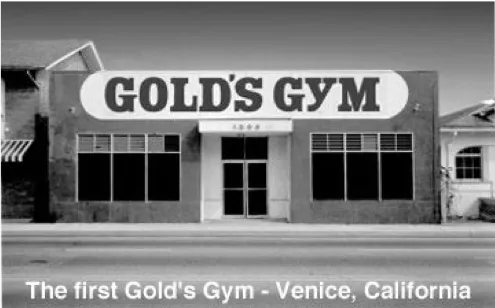
Gold's Gym, Venice Beach, California.
At this point, the Gold’s brand took off and established itself as an iconic global brand. As of 2019, the company had approximately 700 clubs in 29 countries, with nearly 550 of those operations franchised. The franchising model used by Gold’s paved a path for many of today’s most recognized fitness brands such as Anytime Fitness, Planet Fitness, Orangetheory and Snap Fitness, all of whom use a franchise model.
Midtown Tennis – The first indoor tennis club (1969)
Founded by industry legend Allan Schwartz and his father, the Midtown Tennis Club (known today as Midtown Athletic) became the first indoor tennis club in America. The Midtown Tennis Club was the first of its kind in the health/fitness facility industry. It was the first club facility to establish a trademarked and patented tennis program, called ‘Tennis in No Time’. The Midtown Club also became a template for future multipurpose sports clubs when it converted a portion of its tennis space into other athletic uses. Most recently, Midtown added a hotel to its campus, becoming one of the first clubs to also have a namesake hotel.
Lucille Roberts Health Clubs - The first women-only club chain (1969)
Lucille Roberts developed the first chain of women-only health/fitness clubs. It was the first company to see the value of providing women with a non-intimidating environment for exercising (clubs before Lucille Roberts were either predominantly male or co-ed facilities where women worked out on alternate days).
Roberts’ facilities featured an environment that targeted women by offering group exercise and “babysitting” services. The clubs also offered educational opportunities to help women achieve their professional ambitions. The company currently operates 16 women-only clubs in the New York metropolitan market and was recently purchased by Town Sports International.
24 Hour Fitness – The first 24/7 fitness club chain (1983)
Originally founded in 1983 by Mark Mastrov, 24 Hour Fitness has evolved into one of the largest fitness club operators in the world, with over 400 clubs in the U.S. and revenues exceeding US$1.5bn. 24 Hour Fitness established a template for 24/7 fitness clubs, as well as creating a standardized template for building an organic national brand. 24 Hour Fitness is most recognized for being the first club company to leverage a partnership with private equity, raising both equity and debt to fuel multiple regional acquisitions and rapid organic growth. 24 Hour Fitness was also the first company to develop celebrity-branded clubs, collaborating with the likes of Magic Johnson, Andre Agassi and Jackie Chan.
McFit – The first scaled budget club operation (1997)
McFit was founded in Germany in 1997 by Rainer Schaller. At the time, McFit was just another new club on the market, but over the next decade, it evolved into a showcase for the industry’s most popular business model of the 21st Century (i.e. no-frills, low-cost gym or budget club). Schaller’s club model was based on delivering a convenient, user-friendly, no-frills, high-tech and extremely affordable club model to the masses.

McFit club.
McFit showed operators around the world the potential of the budget club model, spurring the rapid development of low-cost club models throughout the industry (i.e., Basic-Fit, Crunch, Planet Fitness, Smart Fit, The Gym Group, and others). The McFit model was one of the first to integrate a minimally-staffed ‘low-touch’ model with a high-tech approach to member service, member communications and club operations.
In summary
Not only is this an interesting insight into the past. By exploring the influential fitness constructs and facility offerings of the past few hundred years, we can see what has helped shape the modern fitness industry – and open our minds to ongoing innovation.
This article was first written in 2019 by the late Stephen Tharrett, former president of IHRSA, co-founder of ClubIntel, and fitness industry icon who left an indelible legacy after more than 30 years in health and fitness. It has been extracted, with minor changes, from the book, Legends of Fitness, authored by Peterson, O’Rourke and Tharrett
FIt Planet sign up
Sign up to Fit Planet and get fresh health and fitness news and advice straight to your inbox.
FIt Planet sign up

Fit Planet
High performance mindset: what we can learn from elite athletes

Fit Planet
Home exercise hacks: The tips home exercisers swear by

Fit Planet
Why exercise fights depression: scientists uncover how muscles talk to the brain

Fit Planet
Exercise for mental health: What the research says about feeling happier, healthier, and more resilient
Fit Planet
How to become a group fitness Instructor: A step-by-step guide

Fit Planet
Why music makes exercise feel easier, more enjoyable, and more effective

Fit Planet
Are you eating enough to support your workouts? 7 signs you're under-fueling your training

Fit Planet
10 signs you'd make a great group fitness Instructor

Fit Planet
Does exercise help you lose weight? What the science really says

Fit Planet
How much strength training do you need to live longer? Scientists say 90-120 minutes per week

Fit Planet
Should you change your workouts based on your menstrual cycle?

Fit Planet