Fascinating fitness history part 3
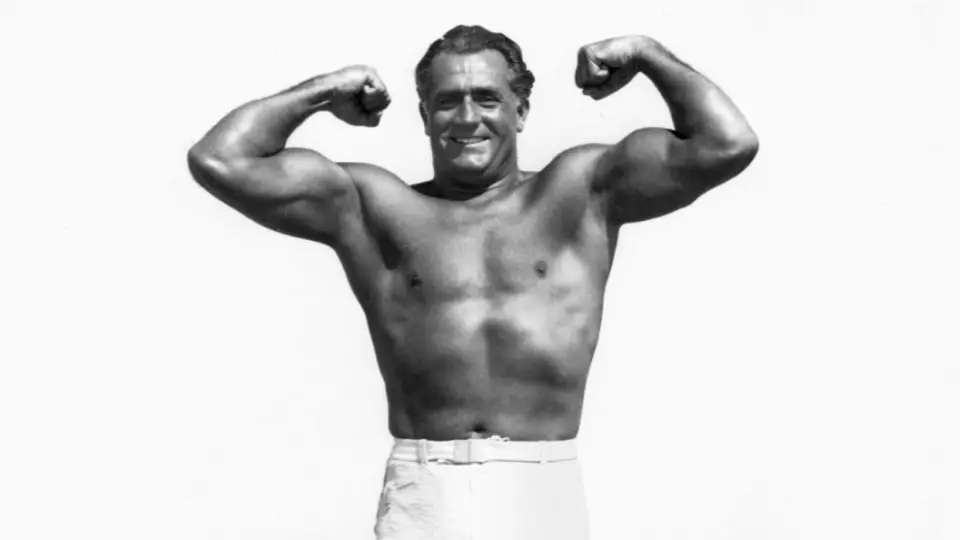
Curious about the pioneers who set the stage for today’s fitness era? Join us as we spotlight the colorful cast of innovators who shaped the industry and set the scene for modern fitness training. This deep dive was written by the late Stephen Tharratt – who is also considered an icon in the fitness world.
Babe Ruth, one of baseball’s most endearing legends, was once asked about the difference between a hero and a legend, to which he responded: “Heroes get remembered, but legends never die”.
The quote has become legendary itself, oft used by those seeking to inspire future generations. What did the Babe mean when he said: “Legends never die”? I believe he was speaking to the enduring power of legends as symbols of their culture, to their unrelenting and ongoing influence on the spirit of those who follow in their footpaths, and finally, to their ability to ground a culture in the face of constant change. Without legends, the underlying fabric of a culture, whether a nation, family, or, in the case of this article, an industry, requires that we never allow the legends to die, for if they do, so does the fabric of who we are. Helen Hayes, an accomplished actress, may have said it best when speaking to the eternal power of legends: “Legends die hard. They survive as truth rarely does.”
Legends of Fitness – Pre-Modern Era
In this section, we will introduce nine individuals whose contributions to the fitness industry prior to the modern fitness industry (modern era starting in 1946), set the stage for what the fitness industry and fitness training are today.
Hippocrates (460 BCE. – 375 BCE.)
Hippocrates is regarded as the father of medicine, particularly as it relates to the ethics of medicine as framed in the Hippocratic Oath. While historians debate the real extent of Hippocrates' achievements, his legend, built on story and myth, continues to influence the modern ethical practice of medicine. One area of influence, oft-forgotten but incredibly important to the world of fitness, was his influence on exercise and nutrition as medicine. Among the numerous quotes attributed to Hippocrates, the one that stands out in respect to the principle of exercise and nutrition as medicine says: “If we could give every individual the right amount of nourishment and exercise, not too little and not too much, we would have found the safest way to health.” These words of wisdom remain as true today as they did over 2,000 years ago, and are a powerful reminder of the role exercise and nutrition play in fostering health. In addition to his teachings and practices around movement, nutrition and health, Hippocrates is also credited with the development of the medicine ball. If nothing else is considered, these two contributions alone remain a cornerstone of the practice of fitness.
Frederick Ludwig Jahn (1778 – 1852)
Physical education historians often refer to Frederick Ludwig Jahn as the father of modern gymnastics and the developer of Turn, a physical culture club (gym) built around gymnastics and the mutual social and martial interests of its members. Jahn created the pommel horse, parallel bars, horizontal bars, vaulting blocks, and the ladder, all of which became mainstays in athletic facilities of the time. Many of his innovations have become linchpins of today’s functional training movement. In 1811, he established what is believed to be the first fitness or gymnastics club, Public Turn Platz. The Public Turn Platz was initially conducted in an open field, offering men and boys group exercise classes designed to help them become physically fit to protect their country. The first Turn incorporated exercises employing parallel bars, the pommel horse, and horizontal bars, as well as integrating dumbbells and Indian Clubs. By 1860, over 150 Turns, often called Turnverein, had spread across the globe.
Pehr Henrik Ling (1776 – 1839)
Ling is frequently referred to as the father of Swedish gymnastics (originally referred to as Swedish Pedagogic Gymnastics); a training approach built around four core principles – medical, military, pedagogical, and aesthetic. Along with German-style gymnastics, Swedish-style gymnastics served as one of the two founding fitness training approaches leveraged by trainers and gyms in the 19th Century. Ling’s form of fitness training is also credited with giving birth to chiropractic medicine and osteopathic medicine. His training approach also integrated mind-body practice, combat training, bodyweight movement, and the use of accessories such as dumbbells, medicine balls, and kettlebells.
Catherine Beecher (1800 – 1878)
Catherine Beecher was renowned for her contributions to advancing exercise and nutrition for women. Beecher co-founded her first school for women in 1823, called the Hartford Female Seminary in Hartford, Connecticut. It was during her tenure at the Hartford Seminary that she introduced callisthenics exercises for women. In 1831, she wrote an essay entitled, “A Course in Calisthenics for Young Ladies,” outlining her approach to exercise for women. Later in 1833, she and her father opened the Western Female Institute, where she expanded her innovative callisthenic exercises for women that involved performing lightweight resistance exercises for multiple repetitions, almost always to music. Over the next several decades, her callisthenic exercises for women grew in prominence, finally gaining acceptance as ‘proper’ for women of the period. In 1856, she authored a book entitled, Physiology and Calisthenics for Schools and Families, in which she laid out her style of gymnastics for women. Beecher’s callisthenic exercises were ground-breaking and led to her being anointed in many circles as the founder of American-style gymnastics for women. In 1873, she wrote another book called Housekeeper and Health Keeper in which she laid out further guidance for physical exercise and diet for women.
Leo Durlacher (1844 – 1924)
Durlacher, also known as Professor Attila, is considered by many to be the first master trainer and strength coach. Professor Attila trained many of the great strength athletes of the late 19th and early 20th centuries. Attila established his first gym in Brussels, Belgium, in the 1880s; opened a second gym in London in the late 1880s; and finally founded Professor Attila’s Athletic Studio and School of Physical Culture in New York in 1894. Attila was the creator of the Globe barbell, the Roman chair, and the Roman column. He also served as a personal trainer to celebrities of the time, including Louis Cyr (a Canadian strongman and one-time world’s strongest man), Gentleman Jim Corbett (one-time heavyweight boxing champion), Cornelius and Alfred Vanderbilt, J.P. Morgan Jr., Baron Rothschild, John Philip Sousa, Alexander III, Czar of Russia, King Edward VII of England, King George of Greece and Queen Mother Alexandra of England. Professor Attila is considered by many to be one of the first proponents of progressive resistance training for women and seniors.
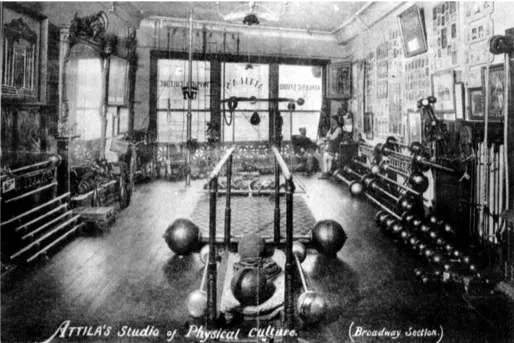
Attila's studio of physical culture.
Dudley Allen Sargent. M.D. (1849 – 1924)
Dudley Sargent might be considered the “father” of evidence-based physical education, as well as the principal advocate of variable resistance training machines. By the age of 19, Sargent was a medical student at Yale, where his interests evolved to focus on the scientific basis of physical education. In 1879, he was appointed as an Assistant Professor of physical education at Harvard and Director of Hemenway Gymnasium at Harvard. At approximately the same time he was appointed to the Harvard faculty, he established a private gym in Cambridge called the Sanatory Gymnasium, which catered to exercises for women at the Harvard Annex (later to become Radcliffe).
During his tenure at Harvard, he went on to pursue his two visions. The first was to study, research and codify the perfect physical proportions of the human body, which led to him codifying anthropometric measurements and using these to create personalized exercise programs for each individual he worked with. Sargent’s second vision was to create machines that would bring balance to the development of the human physique. Ultimately, it was these two visions that drove him to establish an entire system based on the use of physical measurements and machines. Sargent designed his own exercise equipment, occasionally in collaboration with the famous Swedish physical culturist and physician, Gustav Zander. At Harvard, he created approximately 36 distinct variable resistance pulley machines, including the Chest Pulley, Abdominal Pulley, and numerous other machines. He is credited with developing the pulley systems (adjustable weight plates on pulleys) that have become a staple of gyms around the world. One interesting creation of Sargent’s was the creation of a counter-weighted parallel bar, which allowed weaker individuals to perform dips (an early version of the Stairmaster Gravitron). Finally, many of the exercises he designed for his pulley machines, such as the wood chop, sawing and swimming are staples of today’s functional training protocols.
Eugene Sandow (1867 – 1925)
In the 1880s, Sandow, a student of Professor Attila, established himself as one of the most well-known and affluent strongmen in the history of physical culture. Sandow was a strongman, entertainer, health educator, trainer, and celebrity. He established numerous records in strongman competitions and is considered by many to be the first bodybuilder. He developed several pieces of training equipment, including the 'The Sandow Physical Training Leg Machine', and his special-grip dumbbells. He also authored numerous books, including Sandow’s System of Physical Training (1894); Strength and How to Obtain It (1897); The Gospel of Strength According to Sandow (1902); and Bodybuilding by Sandow (1904). In 1897, he opened a gym facility – The Institute of Physical Culture – that was dedicated to providing advanced training techniques to aspiring professionals in the field of physical culture. He laid the foundation for modern bodybuilding, but also for many of today’s modern training techniques.
Bernarr Macfadden (1868 – 1955)
Macfadden (original name was Bernard McFadden) is often called the father of physical culture and possibly the most influential fitness personality of the late 19th and early 20th centuries. In 1894, he created the Macfadden exerciser, and in 1899, he opened the first in a series of physical culture clubs. In 1899, he published his first issue of Physical Culture – a magazine dedicated to the pursuit of physical culture and health – that by 1903 had a circulation of over 100,000. The magazine ran for 50 years and had, at the tim,e the longest circulation run of any health and fitness magazine in U.S. history. In 1911, he published the first edition of Macfadden’s Encyclopedia of Physical Culture, a publication that went on to have seven separate editions (the ultimate textbook on physical training).
Macfadden also established the Macfadden Healthatorium, a school for educating aspiring physical culturists in alternative health practices. In addition, he established the Bernarr McFadden Institute, a school for training professionals in physcultopathy. Macfadden eventually became a multi-millionaire and the first to make their fortune from the fitness industry. A quote that appeared in a 1906 issue of his Physical Culture Magazine speaks to Macfadden’s vision for the future of fitness: “When the importance of physical culture is recognized, when men and women realize its true importance, it will enter into every phase of human life. There is hardly a question in life that physical culture should not be a part of”.
Charles Atlas (1892 – 1972)
Atlas, born Angelo Siciliano in New York, was a protégé of Bernarr Macfadden. In 1921 and again in 1922, Atlas earned the title of World’s Most Perfectly Developed Man. After his second victory, Macfadden took Atlas under his tutelage, introducing him to Dr. Frederick Tilney, a homeopathic physician and physical culturist. Together, they authored a training course on muscle control and isometric opposition exercises that eventually encompassed 13 lessons. By 1929, the three men had incorporated as Charles Atlas, Ltd, a mail-order and in-home exercise company (think of it as an older version of Les Mills On Demand, Daily Burn or Freeletics).
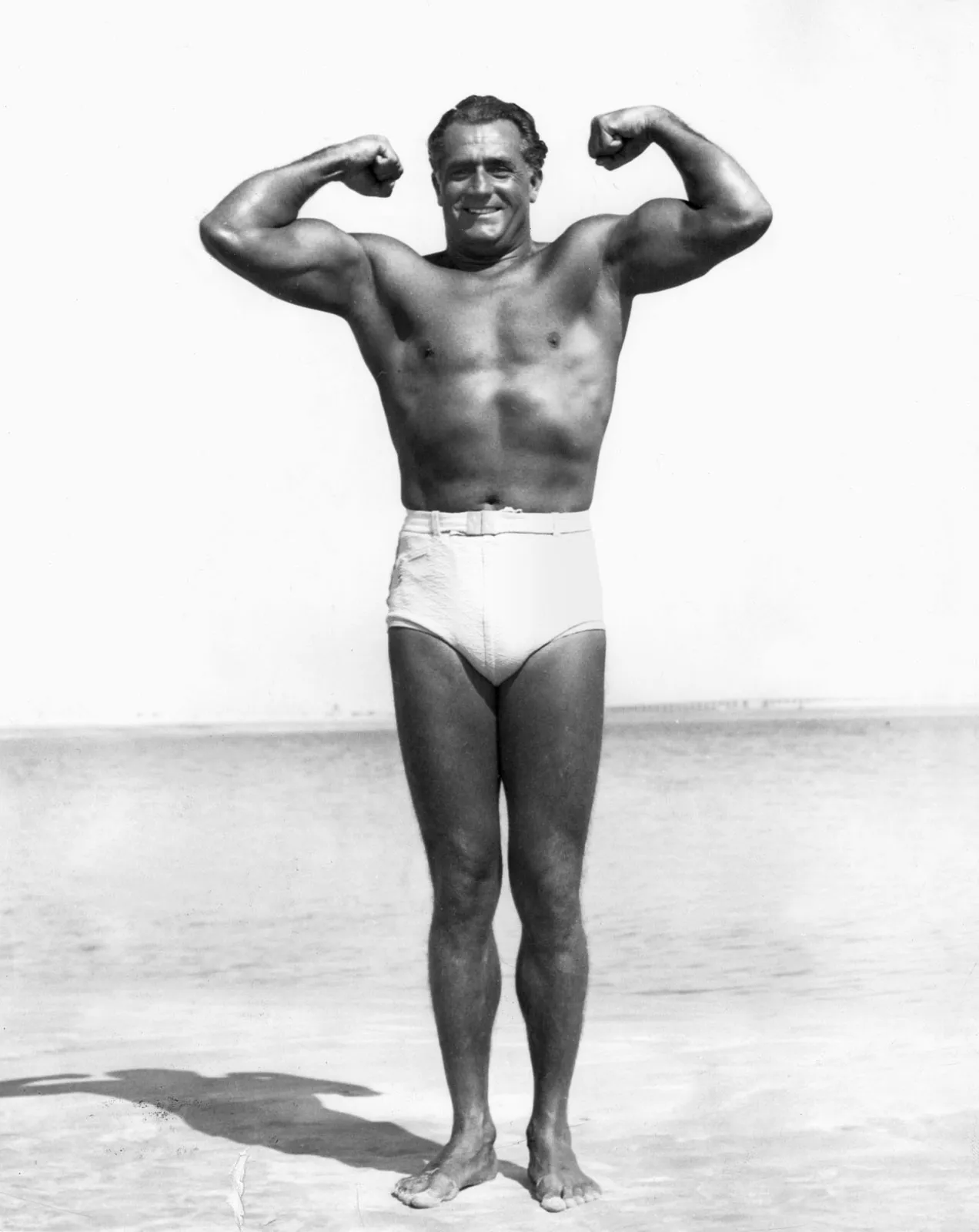
Charles Atlas.
Atlas’s reputation grew when he teamed with Charles Roman, who became the marketing genius behind Charles Atlas, Ltd., coining the phrase 'dynamic tension', and creating the themes for all of the Charles Atlas advertisements. Concurrently, Roman began placing ads in comic books, which, at the time (the period of the Great Depression), were incredibly popular among young men (an old-time version of today’s in-game and mobile advertising). It was the unique blend of Atlas’s persona and personal selling skills, Roman’s incredible marketing savvy, and the arrival of the great depression that took Atlas to the pinnacle of the mail-order fitness business. It’s worth noting that his courses are still selling today, 80 years after they were introduced. What set Charles Atlas apart the most and helped establish a legacy that still stands today, was his unique ability to personalize his program for everyone, while still maintaining a high-volume sales approach. Forbes Magazine called Atlas a “super salesman,” but his millions of students saw him as their teacher, coach, and personal guide to physical perfection.
Legends of Fitness – Modern Era
In this section, we look at eight individuals whose contributions to the fitness industry, post-World War II, set the stage for the modern fitness industry.
Joseph Pilates (1893 – 1967)
Joseph Pilates developed the floor exercises and equipment movements that now bear his name, and are offered in fitness clubs and fitness studios around the world. Not only did he create the Pilates method of exercise, but he also invented most of today’s Pilates equipment. His innovative equipment utilized the few items that were available to him at the time (period of World War I), like bed springs and beer key rings. His initial resistance training apparatus was the forerunner of today’s modern Pilates equipment, such as the reformer and magic circle. Pilates’ exercise mind-body system, called Controlology, was inspired by his attraction to Zen Buddhism and various Eastern practices.

An early Pilates studio.
Bob Hoffman (1898 – 1985)
Known as the “father of American weightlifting,” Hoffman influenced physical culture, in particular weightlifting, for a period of approximately 40 years. Hoffman initially got involved in the business of fitness equipment in 1929 when he began to manufacture barbells. Around the same time, he created a weightlifting club, called the York Oil Burner Athletic Club, that soon became home to many of America’s greatest weightlifters. In 1932, with one of his mentors, George Jowett, he created the Strength and Health Publishing Company. The company published the first issue of Strength and Health Magazine in 1932 (the magazine was a twist on the older British magazine, Health and Strength). Hoffman’s magazine initially promoted physical culture, but soon thereafter, the magazine became the vehicle that allowed Hoffman to promote and sell his products to men around the country.
In 1935, Hoffman purchased the assets of the Milo Barbell Company, once the leading manufacturer of weightlifting equipment in the United States. By 1938, Hoffman had not only founded the York Barbell Company, he was also firmly established as the “guru” of physical culture and weightlifting in America. By 1938, he had taken a dominant, nearly monopolistic hold on the physical culture business in America. Hoffman, along with others mentioned in this article, reshaped the landscape of physical culture in America. Over the course of four decades, his empire became the most influential force in physical culture, with his equipment appearing in homes and gyms across America.
Vic Tanny (1912 – 1985)
Vic Tanny might well be considered the father of modern health clubs. In 1947, he opened a new type of gym in Los Angeles, a facility dedicated to serving the new post-war middle-class suburban market. His new clubs, aptly named Vic Tanny’s, welcomed men and women (offering alternate day workouts). Vic Tanny health clubs were different than other facilities of the time. Instead of open spaces with lots of weightlifting equipment, his clubs featured mirrors, carpet, chrome, saunas, pools, and gym areas. His clubs sold memberships on contract, with consumers having the opportunity to purchase a six-month contract, or if they preferred, a permanent seven-year contract.
By 1960, Vic Tanny’s had evolved into a chain of 84 clubs, becoming the largest health club operator in the U.S., with approximately one million members and $24 million in annual sales (slightly more than $200 million in 2019 dollars). Vic Tanny’s clubs are also the father of the hard sell, price discounting, and high volume, ‘do-anything-to-get-the-customer-to-join’ approach to membership sales. In an article that appeared in Time Magazine in 1961, Vic Tanny is quoted as saying, “volume is what counts.” While the Vic Tanny business model has left unfortunate scars on the industry’s reputation, some of which still linger today, it was his innovative approach to club positioning and his introduction of membership contracts that set the stage for operators such as Bally Total Fitness, 24 Hour Fitness, LA Fitness, and Lifetime Fitness.
Jack LaLanne (1914 – 2011)
LaLanne may well be the most influential fitness legend of the post-World War II era. In 1951, he became the host of a nationally syndicated TV show – the Jack LaLanne Show – America’s first telecast dedicated to the pursuit of fitness. LaLanne’s show brought fitness into the homes of millions (think social media influencer scale before there we had Facebook or Instagram). Every morning across America, housewives and children actively followed along to LaLanne’s fitness routines in the comfort of their homes. Over the next 34 years, concluding in 1985, Jack LaLanne became the face of fitness. He is credited with inventing the “Smith machine” (named after Rudy Smith, a club pioneer who brought the piece to market) and the leg extension machine, both staples of the modern fitness center. LaLanne went on to become the most recognized name in the health spa and gym business. For an extended period of time, his name was associated with over 200 clubs, initially beginning with Ray Wilson’s European Health Spas, which, in turn, became Jack LaLanne European Health Spas, and later merged into the Bally empire.

Jack LaLanne.
Arthur Jones (1926 – 2007)
Jones was the inventor of the Nautilus Variable Resistance Machine. When his first prototype, the Blue Monster, was introduced in 1970, it permanently changed the course of the commercial fitness industry. It was his development of the revolutionary Nautilus CAM and variable resistance that changed how people exercised, in particular, how non-athletes pursued resistance training. It allowed resistance training to reach the masses. His efforts fostered the development of the modern equipment company, when his Nautilus Company became the largest manufacturer of fitness equipment, achieving sales of close to $75 to $80 million in the late 1970s (equivalent to $300 to $325 million in 2019).
Jones’ most consequential contribution to the world of fitness may not have been the Nautilus equipment, but instead his core principles of training, including performing one set to exhaustion while training, super-slow controlled concentric and eccentric training, and 20-minute circuits (as of 2019 there are gym franchises that promote the super slow 20-minute circuit). 40 years after he introduced Nautilus to the world, the Nautilus name remains the “Kleenex” of the equipment industry.
Jacki Sorenson (1942 – present)
Jacki Sorenson is credited as the modern-day founder of “aerobic dancing”, having combined choreographed dance movements with “aerobic” training (something she picked up from working with Kenneth Cooper, M.D., the modern-day founder of aerobic training). Her introduction to fitness started when she was asked by the Air Force to develop a television-oriented physical activity program for the wives of Air Force staff. From this introduction, Jacki brought her choreographed group exercise program to the YMCA of America, where it quickly spread to YMCAs throughout the U.S., and by 1980, it had evolved into one of the most popular forms of exercise for women across the globe. Her unique brand of group exercise is still taught around the globe today.
Augie Nieto (1960 – 2023)
Augie Nieto, along with Arthur Jones, helped to shape the way the fitness industry operates today. Nieto, one of the co-founders of Life Fitness, was initially the chief sales advocate for the Lifecycle, the fitness industry’s first digital piece of cardiovascular training equipment. While he was not the inventor of the Lifecycle, Nieto was an original investor in the company and was the individual who brought the Lifecycle to market. By any objective measure, Lifecycle changed the way people exercised in clubs. By the late 1970s, the Lifecycle was the top-selling piece of cardiovascular equipment in the industry, and would help foster the development of the largest equipment manufacturer in the world, not to mention spur the development of an entire equipment segment (cardiovascular equipment). While the introduction of the Lifecycle and the creation of Life Fitness are Nieto’s primary legacy, it is his other contributions to the industry that may actually last longer. As the president of Life Fitness, his support and sponsorship of the fledgling club association, IHRSA, helped provide the financial impetus for the association’s rapid ascension as a global industry trade association. It was Nieto’s vision and financial support that helped initiate the first European leaders meeting, as well as helping establish similar global events around the world. Nieto was a compelling apostle for fitness, using the platform of Life Fitness and his subsequent other ventures to promote the benefits of fitness worldwide.
John McCarthy (1937 – present)
John McCarthy was the first executive director of IRSA, which today is known as IHRSA, serving in that position for 25 years, starting with its inception in 1981. McCarthy, working with the original founding members of IRSA, helped to build a global trade association that currently represents nearly 10,000 clubs around the globe. When the association first started, McCarthy focused on building an organization that would support the core mission of promoting an association of quality clubs. Over the years, McCarthy, more than anyone in the industry, had an insightful vision of what the future held for the fitness industry. In the process, he led IHRSA toward a global, all-encompassing effort to be the voice of the industry, both domestically in the U.S. and globally.
He pioneered efforts to establish credibility for the industry and led the way in helping club operators focus on developing their professionalism. His dynamic personality and incredible relationship skills enabled him to foster global relationships, which brought club operators from around the world together, thereby creating an association that inspired innovation and sharing among its members. McCarthy also helped bring operators and vendors together. It was part of McCarthy’s core vision that the health/fitness club industry would become an integral part of every global citizen’s lifestyle, not just a discretionary luxury. Over his 25-year tenure at the helm of IHRSA, he became the spokesperson for the fitness facility industry – an industry that today encompasses over 210,000 facilities worldwide.
Final thoughts
As stated in the introduction, legends are individuals whose influence is timeless. Their aura is often as powerful today as when they first emerged on the scene. Their influence survives, as Helen Hayes said, “…as truth rarely does.” In this article, I’ve brought forward the individuals whose influence on our industry I believe to be everlasting and therefore legendary. Chances are I’ve missed some of the legends, not intentionally, more so as a result of my own personal experience in the fitness industry over the last 40 years. My hope is that readers don’t allow these legends, or their contributions, to fade from the collective memory of the fitness industry. If that is allowed to happen, we are doomed to repeat the past, or worse, lose the essence of our identity.
This article was first written in 2019 by the late Stephen Tharrett, former president of IHRSA, co-founder of ClubIntel, and fitness industry icon who left an indelible legacy after more than 30 years in health and fitness. It has been extracted, with minor changes, from the book, Legends of Fitness, authored by Peterson, O’Rourke and Tharrett.
Sign up for Fit Planet
Sign up to Fit Planet and get fresh health and fitness news and advice straight to your inbox.
Sign up for Fit Planet

Fit Planet
High performance mindset: what we can learn from elite athletes

Fit Planet
Home exercise hacks: The tips home exercisers swear by

Fit Planet
Why exercise fights depression: scientists uncover how muscles talk to the brain

Fit Planet
Exercise for mental health: What the research says about feeling happier, healthier, and more resilient
Fit Planet
How to become a group fitness Instructor: A step-by-step guide

Fit Planet
Why music makes exercise feel easier, more enjoyable, and more effective

Fit Planet
Are you eating enough to support your workouts? 7 signs you're under-fueling your training

Fit Planet
10 signs you'd make a great group fitness Instructor

Fit Planet
Does exercise help you lose weight? What the science really says

Fit Planet
How much strength training do you need to live longer? Scientists say 90-120 minutes per week

Fit Planet
Should you change your workouts based on your menstrual cycle?

Fit Planet