5 THINGS ALL RUNNERS SHOULD KNOW

Watch and learn how to perfectly tune your running technique so you can perform at your best. Discover five fundamental technique tips – plus the one thing that’s most likely to slow you down.
Read on and you’ll discover:
- The five important things to focus on as you run
- Why lack of symmetry is the #1 issue runners should focus on
- A checklist to help identify where your running could be going wrong
- Science-backed ways to alleviate asymmetry
- A link to audio-only run coaching designed for improved run performance
At this very moment, there are probably millions of runners out there pounding the pavement or training on the treadmill. Globally, 621 million of us say we run regularly and 59 percent of active adults choose exercising outdoors, such as running, as a preferred way to stay fit. In 2022 the number of runners who ticked off a marathon nearly doubled compared to 2021.
Running is a hit because it provides all the benefits of endurance exercise (such as reducing blood pressure, total cholesterol, LDL cholesterol, triglycerides, fasting glucose, and body fat), while at the same time elevating oxygen consumption and HDL cholesterol. And as a weight-bearing activity, it improves bone density. Running is also something most of us can do with little effort and cost, as well as being a viable option for all levels of fitness.
Whether you're just starting on your running journey, or you've been clocking up miles for years, five important technique tips will help ensure your running is as enjoyable and effective as possible. Les Mills Trainer, Ben Main, explains below…
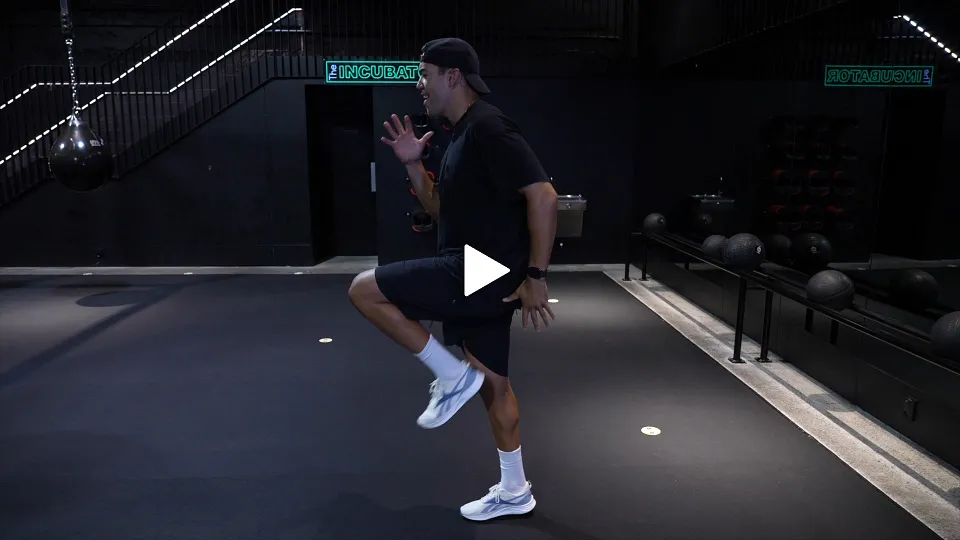
5 things to focus on as you run
#1 Foot strike
Land softly with your foot directly underneath your hip.
#2 Transition
Push from the rear part of your foot, through the middle of your foot and then push off with your toe. It should feel like you step, roll, and push with momentum going forward.
#3 Core activation
Engage your core to lift your chest up and establish a good running posture.
#4 Symmetry
Find balance so that all movements are the same on both sides. (Read on for more important advice on symmetry.)
#5 Flow
Aim for long, fluid strides to improve running efficiency and movement.
Given the numerous health benefits associated with running, it's no surprise millions of people are clocking up so many miles on their feet. Unfortunately, they're also clocking up plenty of injuries along the way. Up to 70 percent of competitive and recreational runners report getting injured yearly, with knee injuries the most common issues.
Dr. Jinger Gottschall, a professional sports and fitness research scientist and long-time running enthusiast, says this high incidence of injury is often related to not properly addressing muscular imbalance.

Where runners go wrong: Lack of balance
If there’s one thing any runner should do, it’s focus on symmetry.
Lack of symmetry creates a greater risk of injury and causes unnecessary energy output – which makes for a real challenge with it comes to unleashing your true potential.
Gottschall explains that symmetry is key to safe and effective running. “Running really is a three-dimensional activity and, while your legs are moving forward on one plane, the movement of your arms and torso is also important for force production and energy minimization.” She says when you’re moving in this way it’s important to be symmetrical because a single leg is in contact with the ground at a time, supporting body weight. "If one leg is dominant at any particular joint, you produce more force or absorb more impact. As a result, the muscles on the non-dominant side are not as strong and the joints on the dominant side are wearing down."
Asymmetry can be due to many possible conditions; pelvic (hip) rotation, arthritis at the knee, and greater strength of the left/right ankle muscles are just some of the common causes of imbalance. Most imbalance occurs between the knee and the ankle – but it’s certainly not limited to this area.
CHECKLIST: Are you dealing with asymmetry?
- Identify if you have pain on a single side, or if you notice increased tightness on a single side when stretching – this is a sure sign of asymmetry
- Bring awareness to your foot strike pattern to see whether you land more heavily on one foot, or spend more time on the ground with one leg.
- Get a friend to film you running at a steady state speed (with the camera angle either directly in front or behind you). Watch the footage and look for any differences between how your legs land and take off.
- If you suspect a large amount of asymmetry or feel pain and/or tightness on one side, it’s a good idea to be evaluated by a physical therapist, who will help determine any specific muscle weakness.
How can you alleviate asymmetry?
Some suggest strength work, such as single legs squats, can help the issue, but that’s just part of the picture. Gottschall recommends supplementing regular running with a low-weight, high repetition full-body weight training workout, like BODYPUMP™.
“It’s the ideal way to strengthen the muscles around the joints, and not just in your legs,” she says. “Even bicep curls and dead rows are helpful, because your elbows are flexed during running and strong upper body posture is helpful for endurance events.”
Introducing integrated core training is a very smart move, adds Gottschall. “It can be extremely beneficial in terms of single leg strength for symmetry, deep hip muscle training for knee alignment, and abdominal training for efficient force transmission”. Research shows that focusing on integrated core training with LES MILLS CORE™ can help you shave over 60 seconds from your 5km run time!
The final piece of the puzzle is dedicating time to the stretching and lengthening of muscles. A workout like BODYBALANCE™ will help reduce injury risk, helping train the core and stretch the working leg muscles, adds Gottschall.
You can tap into run coaching from a team of trainers when you try LES MILLS RUN using LES MILLS+. These audio-only run workouts can be done on a treadmill or outdoors. There are options for all abilities and different formats to keep things interesting.
Running or resting: What’s worse for your knees?
Bryce Hastings, physiotherapist and Les Mills Head of Research, clears up the confusion about running risk, explaining that inactivity is more likely to cause knee issues than running marathons.
The exercises that help you run faster – and improve symmetry
Science reveals focusing on a specific type of integrated core training – not spending more minutes pounding the pavement or tackling the treadmill – could be key to achieving quicker run times and improving running symmetry.
Sign up to Fit Planet and get fresh health and fitness news and advice straight to your inbox. Subscribe

Fit Planet
Exercise for mental health: What the research says about feeling happier, healthier, and more resilient
Fit Planet
How to become a group fitness Instructor: A step-by-step guide

Fit Planet
Why music makes exercise feel easier, more enjoyable, and more effective

Fit Planet
Are you eating enough to support your workouts? 7 signs you're under-fueling your training

Fit Planet
10 signs you'd make a great group fitness Instructor

Fit Planet
Does exercise help you lose weight? What the science really says

Fit Planet
How much strength training do you need to live longer? Scientists say 90-120 minutes per week

Fit Planet
Should you change your workouts based on your menstrual cycle?
Fit Planet
When is the best time to exercise? Morning vs evening workouts explained
Fit Planet
What is CEREMONY HYROX? A complete guide to the new Les Mills x HYROX workouts

Fit Planet