THE CORE COMPARISON
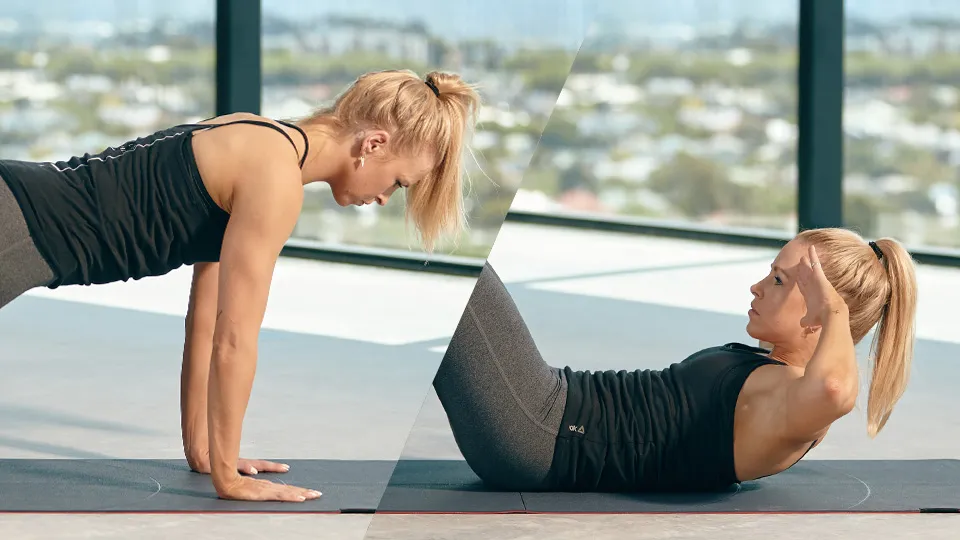
They are the two most popular core training moves, but do they produce the same results? We put the crunch and the plank to the test.
If you’re keen to find the smartest way to work your abs – and enjoy the increased stability, and lower risk of injury that comes from a strong core – here’s where you’ll find it.
Should you plank, or should you crunch?
The crunch is a dynamic movement. It’s a spinal flexion – a forward bend of the spine.
The plank is a static hold. An isometric contraction of the muscles of the spine.
What muscles do you work?
Both the crunch and the plank engage the rectus abdominis and the obliques. However, the plank also targets the erector spinae, the glutes, hip flexors, quads and deltoids.
Why we love these moves
- The crunch is great for isolated conditioning.
- The plank provides increased activation of target muscles and functional strength benefits.
Science shows...
In 2013 the Les Mills research team explored which type of abdominal exercise – isolation or integration – provokes the greater muscle activation. This study highlighted:
- A plank with hand reach gives 20 percent more rectus abdominis activation than a crunch.
- A plank with a knee lift toward the opposite side of the chest increases rectus abdominis activation by 30 percent and external Oblique activation by 20 percent.
THE VERDICT: the plank is the winner
While the humble crunch can work wonders for your core, the plank provides optimal results when it comes to aiding sports performance, rehab and general fitness. So, if you really want to maximize the benefits of your core training the increased muscle activation you get with a plank means it’s the way to go.
When to choose crunches over the plank
If you have weak wrists or shoulders choosing to challenge your core with crunches may be the best bet.
Technique tips: what to watch out for
- During crunches it can be tempting to place your hands behind your head and as a result you can pull forward on your head. This can be avoided if you keep your fingertips at your temples. You should also always keep your chin tucked.
- If, during a plank, your butt is too high in the air the effectiveness of the plank will be reduced. To get the most from this movement you need to keep your body in a long straight line and make sure your butt is down.
The perfect plank prescription
- If you’re new to planking we suggest you start by aiming for three 30 second holds.
- When you’re ready to increase the intensity add knee lifts and hand reaches.
Give a 30-minute LES MILLS CORE workout a go. Featuring a variety of integrated core training exercises, LES MILLS CORE will make you stronger at everything you do.
Find a workout work out on demand
Sign up to Fit Planet and get fresh health and fitness news and advice straight to your inbox. Subscribe
More about the author
Emma Hogan
Emma is a health and fitness writer with 20 years of experience creating evidence-based features that bridge the gap between scientific research and real-world application. Based in New Zealand, she works with global exercise scientists, physiotherapists, and internationally recognized fitness experts to uncover the latest insights in health, fitness, and human performance.
Known for making complex topics accessible and engaging, Emma writes on everything from strength training and recovery to motivation, behavior change, and lifelong wellbeing. Her work helps readers navigate an increasingly crowded health landscape and make informed choices grounded in credible research rather than trends or misinformation.


Fit Planet
High performance mindset: what we can learn from elite athletes
Fit Planet
Home exercise hacks: The tips home exercisers swear by

Fit Planet
Why exercise fights depression: scientists uncover how muscles talk to the brain

Fit Planet
Exercise for mental health: What the research says about feeling happier, healthier, and more resilient
Fit Planet
How to become a group fitness Instructor: A step-by-step guide
Fit Planet
Why music makes exercise feel easier, more enjoyable, and more effective
Fit Planet
Are you eating enough to support your workouts? 7 signs you're under-fueling your training
Fit Planet
10 signs you'd make a great group fitness Instructor
Fit Planet
Does exercise help you lose weight? What the science really says
Fit Planet
How much strength training do you need to live longer? Scientists say 90-120 minutes per week
Fit Planet
Should you change your workouts based on your menstrual cycle?
Fit Planet