/* MAKE SURE TO CHANGE THE NAME HERE AS WELL OTHERWISE CSS WONT CHANGE AND THE POPUP WONT WORK */

Fascinating fitness history part 1

11.11.2025

Fitness

From Ancient Greeks and Russian strongmen, to torture devices and dog-walking gadgets, this article delves deep into how past innovations are shaping the way we work out today.

The birth of fitness equipment, what we might refer to today as fitness training accessories, can be traced as far back as 800 B.C. Over the last 2,800+ years there have been numerous fitness equipment innovations that changed the course of how athletes, fitness enthusiasts and ordinary citizens trained and pursued an active lifestyle. What follows is a list of 15 fitness equipment innovations whose emergence and resulting influence remain in effect even today.

Dumbbells

In the pursuit of greater athletic achievement, the Greek trainers and athletes of 800 to 700 B.C. created the earliest dumbbells. This early versions of the dumbbell went by the name of halteres and were made of stone. Halteres were made in various sizes to provide athletes with varying degrees of resistance. Greek athletes used halteres for a variety of training movements, including lunges, plyometric jumps, running and general resistance training. Over time, these crude dumbbells evolved and by the 1700s were made of wood, and by the late 1800s consisted of a steel handle connecting two globes filled with iron shot. By the turn of the 20th Century, Alan Calvert, the founder of Milo Barbell had created barbells and dumbbells with steel bars that could be loaded with plates. Today’s dumbbells, while definitely more refined than earlier versions, remain highly similar to those first brought forward nearly 3,000 years earlier.
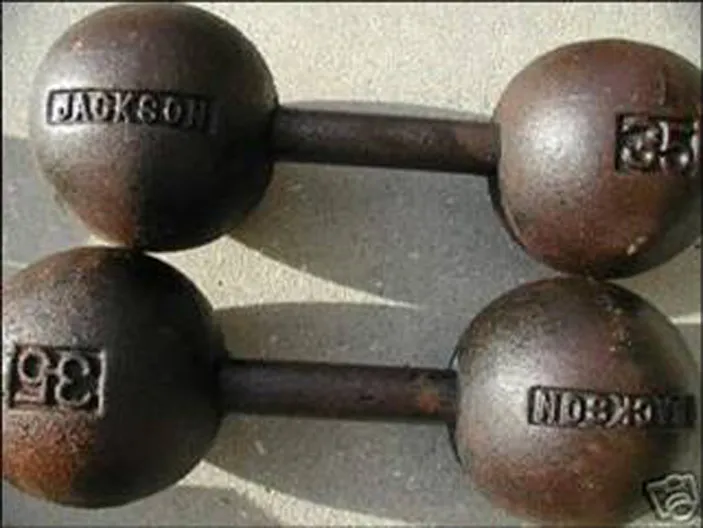
Two vintage globe-style dumbbells made of dark metal with a rusty texture, featuring engraved text “JACKSON” and weight markings “35” on each end, placed on a light concrete surface.

Jackson Globes, the first dumbbell.

Medicine Ball

Around 300 B.C. Hippocrates – the originator of the Hippocratic Oath – introduced the first medicine ball. This was comprised of animal skin wrapped around a sand-filled interior and was used by athletes and fitness enthusiasts for lifting, carrying and throwing. Today’s medicine balls, slam balls, sand bells and sandbags are all modern imitations of the original medicine ball.

Kettlebell

Fast forward to the early 1700s when Russians, eager to demonstrate their prowess in local athletic competition, introduced the kettlebell – what they called the girya. The kettlebell soon became an essential training accessory for strength athletes seeking to enhance their physical prowess. The majority of kettlebells used today are not far removed from the originals used by Russian strongmen.

Barbell

In the 1700s, about the same time the Kettlebell was introduced, fitness practitioners introduced the ‘wand’. This weighted wooden stick was similar to today’s weighted bars, only heavier. The wand soon gave way to the barbell, which was comprised of either wooden sticks or metal bars with weights attached. By the mid-1800s barbells had evolved, comprised of a metal handle with globes on each end, filled with steel shot. These early ‘barbells’ required total body control and engagement of the core. The first plate-loaded barbells, which are the standard today, were introduced around 1902 by Milo Barbell company.
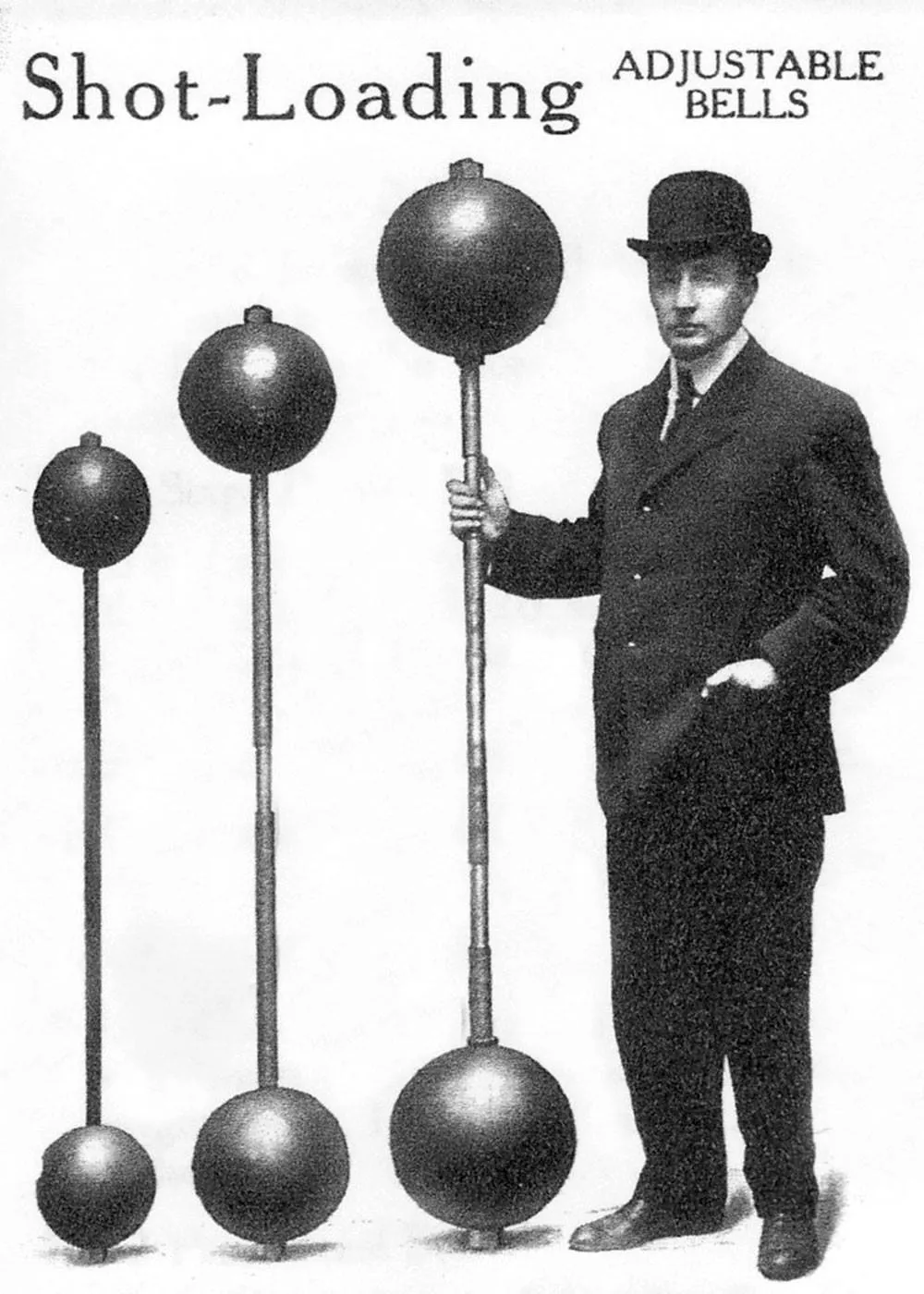
Person in a dark suit and hat standing beside four tall shot-loading adjustable barbells with large spherical weights, arranged in ascending size, against a plain white background with text at the top.


An early advert for barbells.


Indian Club

The Indian Club, introduced to the British military by native soldiers in India during the early 1800s, became a mainstay of physical training among the British military, and later among many global athletes. In 1834, Donald Walker, author of British Manly Exercise, introduced Indian Club exercises to the general male population as a mainstream form of fitness training. In 1866, the seminal textbook for Indian Club training was authored by Sim Kehoe. Today, the RMT club and ONNIT steel clubs offered by Roque are modernized conversions of these original training devices.

Variable Resistance Equipment

The first iteration of today’s variable resistance equipment was introduced in the mid-1800s by Dudley Sargent, a Harvard professor. His machines were called variable-resistance pulley machines. By the late 1880s, Dudley Sargent had created 56 different variable-resistance pulley machines with names such as the abdominal pulley system, the chest pulley system and the back pulley system. By the time he retired from Harvard he had created 56 machines, all housed in Harvard’s Hemenway Gymnasium. Many of his pulley systems became mainstays for early fitness facilities around the globe.

Around 100 years after the introduction of the variable resistance pulley machines, the next innovation emerged with the introduction of the Universal Gym in 1957 by competitive bodybuilder Harold Zinkin. Some of these early devices have evolved little over time, while others are now represented by today’s modern variable resistance machines made by firms such as Life Fitness, Matrix and Technogym. One of today’s modern variable resistance training devices that holds the greatest affiliation with the Sargent pulley systems are the machines produced by Freemotion.  

Progressive Resistance Machines

Around the same time, Dudley Sargent was creating his variable resistance machines, Swedish physician Gustav Zander created his progressive resistance machines employing weights, pulleys, levers, springs, and cams (similar to what the original Nautilus machines had). In total, Gustav Zander created 27 different machines designed to be used for rehabilitative and performance enhancement purposes. The underlying principle behind his machines was what he called progressive exertion, whereby the load placed on the targeted muscles increased throughout the movement. Zander’s progressive resistance machines never really caught on with the public, but they re-emerged with the introduction of Nautilus machines in 1970. Arthur Jones’ introduction of the Nautilus represents the second stage in the evolution of variable resistance machines, offering progressive resistance via a modified cam system. One could argue that the early Nautilus machines were merely an innovative twist to Zander’s machines, some of which used cam-like pulley mechanisms. Today, there are many variable resistance models in existence, including Nautilus, with roots that go back to the first machines of Sargent and Zander.
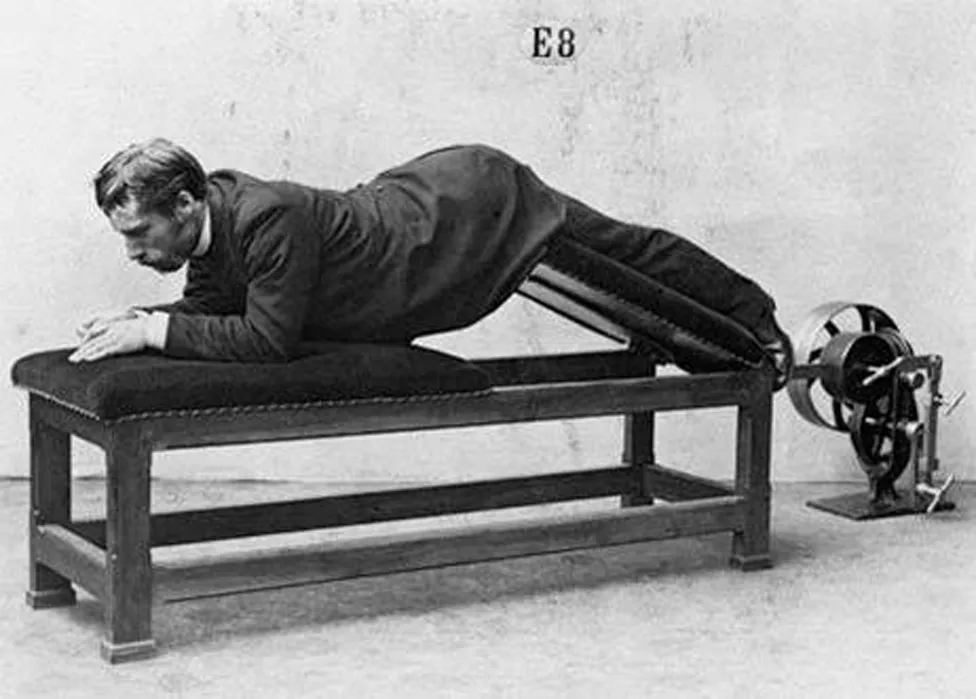
Person lying face down on a padded bench wearing a dark long coat and striped trousers, with legs secured in a mechanical device featuring metal components and a wheel on the right side.


Gustav Zander created his progressive resistance machines employing weights, pulleys, levers, springs and cans.

The Rowing Machine

Up until the 1800s, most cardiovascular training involved walking, cycling and running. In 1871, William B. Curtis introduced the Curtis rowing machine, which became the first piece of cardiovascular equipment designed solely for indoor training purposes. Curtis was an avid rower. As one of the founding members of the New York Athletic Club, which opened in 1868, he developed the rowing machine so individuals could train year-round no matter where they lived. The Curtis Rowing machine used a flywheel and ratchet system, subsequently becoming a template for future rowing machines, including those currently used in clubs and studios around the world.

The Manual Treadmill

As early as the late 1800s, the thought of engaging in cardiovascular activity indoors or on a piece of equipment was nothing short of crazy, or possibly torture. In the 1870s, Nicholas Potter received three separate patents for treadmills collectively referenced as ‘enterprise dog power’. The first patent, which came in 1871, applied to the pivoting track frame. In 1875, the second patent was received for the system used to elevate the platform, followed by a third patent for an adjustable and removable track frame. These early treadmills were called ‘enterprise treadmills’ and still exist today. The first of these manual treadmills were actually used for walking dogs and later evolved into use with humans, similar to today’s many manual treadmills such as Technogym’s Skillmill and Woodway’s Curve and Curve Trainer.
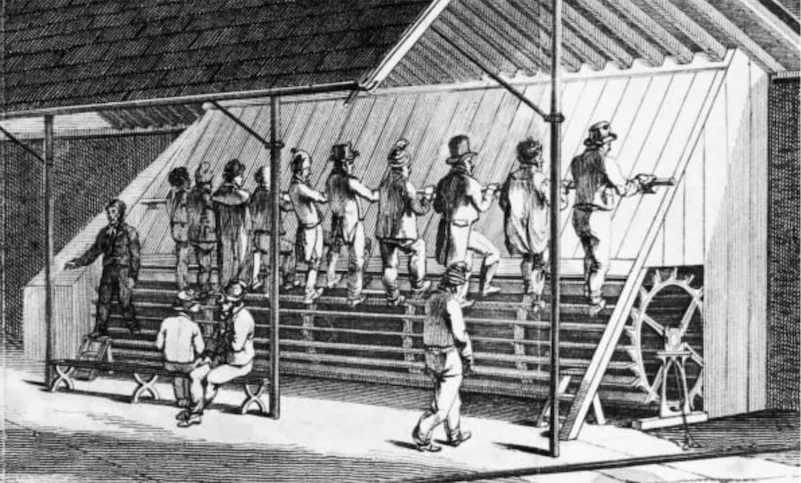
Illustration of a group of people walking on a large wooden treadmill inside a covered structure. Two seated figures and one standing figure observe, while a wheel mechanism is visible on the right side.


A primitive form of treadmill, used as a torture device on British prisoners.

The Powered Treadmill

In 1889, Zuntz and Lehrmann developed the first motorized treadmill. This inaugural motorized treadmill was used in studies of human performance. In 1952, approximately 60 years after the introduction of the first motorized treadmill, Quinton introduced a modernized version called the Quinton treadmill, designed by Robert Bruce and Wayne Quinton. The Quinton treadmill was extremely well-built and became a staple of medical centers and universities. The Quinton treadmill also became the benchmark for today’s treadmills, though few of these modern versions are likely to have the lifespan associated with the early Quinton treadmills.

The Digital Indoor Bicycle

Up until the late 1960s, nearly all indoor bicycles were manually powered, but in 1968, Keene Dimmick introduced something completely new, an electronic bicycle called the Lifecycle. A few years later, Ray Wilson was introduced to the machine and quickly realized that it offered an entirely new element to the equipment currently being employed by fitness clubs. Wilson subsequently purchased the rights to Lifecycle, and soon hired college student Augie Nieto – who would go on to be one of the co-founders of Life Fitness – to bring the Lifecycle to market. Under the entrepreneurial spirit of Wilson and Nieto, the Lifecycle rapidly evolved into one of the two most important innovations to shape the modern-day fitness business. The Lifecycle 2000 was the first piece of ‘aerobic’ training equipment to feature a standardized program for aerobic training, known as the ‘12-minute program’. Around the same time, the Lifecycle 2000 made a splash in the U.S., a German firm launched the Dynavit (1974) – an electronic ergometer whose development was part-funded by Chrysler.

Vintage stationary exercise bike with a black triangular frame, grey metal supports, black seat, and a control panel featuring dials and buttons mounted on the handlebars, set against a white background.


The original Lifecycle.

The Cross-Training Machine

The first powered bicycle designed for indoor use was created in 1932 by Gordon Berg, who was looking for a piece of equipment to counter his wife’s neuromuscular disorder. This resulted in the Exercycle, an exercise device that combined lower- and upper-body movements in a way that simulated rowing, swimming, cycling, and chin-ups. The bike was powered by a small motor that enabled users to go through a range of motion, with varying levels of resistance. The Exercycle was the first piece of exercise equipment that focused on providing cross-functional conditioning, for both the neuromuscular and cardiovascular systems. Many of today’s modern cross trainers are nothing more than modernized updates of this pioneering original.

The Stability Ball

Now a staple fitness accessory used by trainers around the globe, the stability ball was initially introduced by an Italian plastic manufacturer, Aquilino Cosani in 1963 and called the Pezzi ball. The Pezzi ball initially gained fame and fortune thanks to the efforts of British physiotherapist Mary Quinton, who used it with infants. The stability ball gained further prominence when Dr. Suzanne Klein-Vogelbach, director of the Physical Therapy School in Basel, Switzerland, incorporated the ball into her physical therapy protocols for neuro-development. Her exercises were entitled ‘functional kinetics’. Subsequently, American physical therapists called the device a Swiss Ball, which of course has now evolved into the stability ball.

The Stair Climber

The very first stair-climbing machine, then referred to as a treadmill, was created by an English engineer William Cubitt in 1817. These early stair-climbing devices were introduced to torture prisoners by engaging them in intense exercise while concurrently starving them. These early stair-climbing machines were called treadmills, but when you see images of them it quickly brings to mind the first Stairmaster, which used a revolving stair. Beyond these rudimentary torture machines, the first official stair-climbing machine was introduced in 1984 with the launch of The StairMaster 5000 designed by Lanny Potts, one of the three co-founders of StairMaster Exercise Systems. The first Stairmaster 5000 featured rotating stairs. Two years later, in 1986, Randall Sports/Medical, formerly StairMaster, introduced the StairMaster 4000 PT mechanical stair stepper. The 4000 PT went on to become the single most popular piece of cardiovascular equipment in the 1980s and early 1990s. Over the past five years, stair-climbing machines have made a comeback of sorts, with new versions being made by multiple industry vendors.
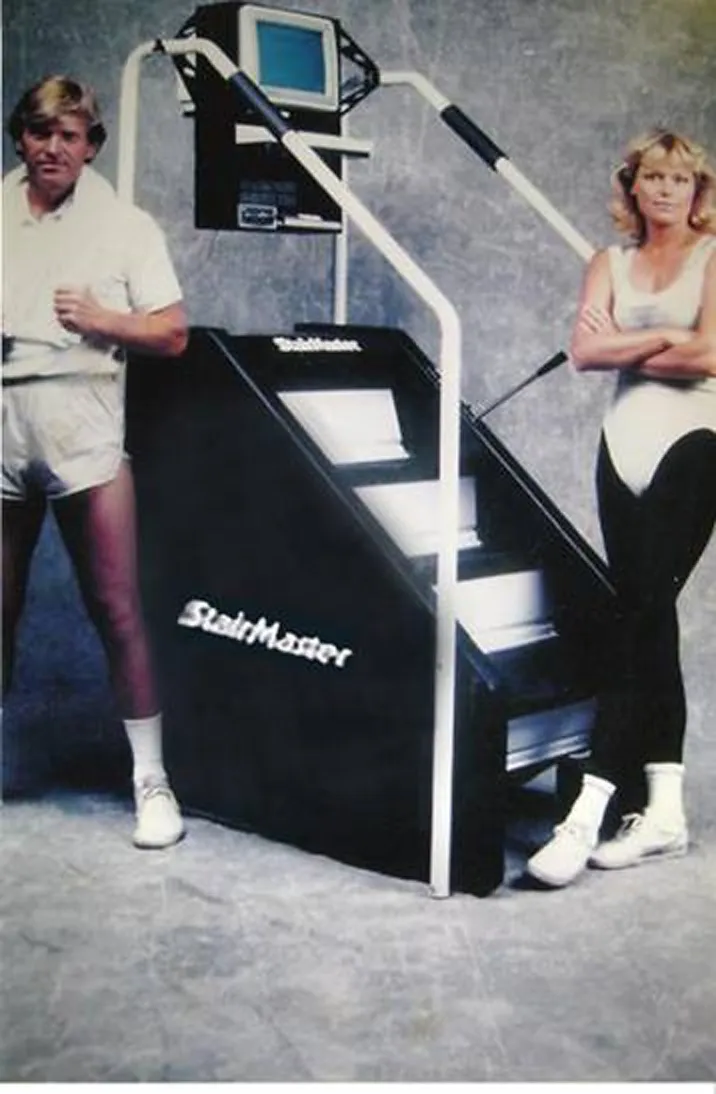
Two people standing beside a vintage black StairMaster exercise machine with white railings and a small monitor on top. They wear white and black workout outfits with white shoes against a grey backdrop.


The StairMaster.

The Elliptical Machine

The most recent non-digital innovation on our list is the elliptical trainer – introduced in 1995 by Precor. The EFX 544, as it became more commonly known in the industry, brought forward an entirely new mode of cardio training. The EFX was designed to provide individuals with a form of cardio training designed to lessen the impact forces associated with using a treadmill. The EFX gained incredible popularity upon its introduction, primarily due to users perceiving it as less intense and less discomforting than other forms of cardio training.


Final thoughts

Thomas Carlyle, a Scottish philosopher once said, “The true past departs not; no truth or goodness realized by man dies; or can die; but all is still here, through endless change.” His words could not be truer when it comes to fitness, whether it’s the equipment, programs or facilities. In this first segment, I’ve brought forward some of the more interesting equipment innovations that I believe have exerted the greatest influence on the evolution of fitness. Or in the words of Thomas Carlyle, the equipment innovations that are still here through endless change.

This article was first written in 2019 by the late Stephen Tharrett, former president of IHRSA, co-founder of ClubIntel, and fitness industry icon who left an indelible legacy after more than 30 years in health and fitness. It has been extracted, with minor changes, from the book, Legends of Fitness, authored by Peterson, O’Rourke and Tharrett.

Want to delve deeper into the history of fitness?  

Discover where the concept of health clubs first began.

Learn about the legends who set the scene for the modern fitness era.

Experience LES MILLS Equipment innovation: Train smarter, move better, and unlock your next level with equipment engineered by physiotherapists and exercise scientists for improved performance, comfort and results.

EXPLORE THE RANGE

Sign up to Fit Planet

Sign up to Fit Planet and get fresh health and fitness news and advice straight to your inbox.

Sign up now

Sign up to Fit Planet

Sign up now

Fitness

 Weight loss jabs: The side effect nobody’s talking about. And how to avoid it

Weight loss jabs: The side effect nobody’s talking about. And how to avoid it

Research highlights the concerning side effect of GLP-1 weight loss medication and why strength training is something all users should do.

Weight loss jabs: The side effect nobody’s talking about. And how to avoid it
How to inspire fitness without saying a single naggy word

How to inspire fitness without saying a single naggy word

Learn 5 expert tactics to motivate your partner, family or friends to start a new fitness routine.

How to inspire fitness without saying a single naggy word
Why it's time to switch up your fitness game

Why it's time to switch up your fitness game

Learn the best way to vary your routine, discover the power of variety and get expert advice on how to mix up your training.

Why it's time to switch up your fitness game
Habit-forming advice and resolution myth-busting

Habit-forming advice and resolution myth-busting

A myth-busting guide to resolutions, backed by habit science.

Habit-forming advice and resolution myth-busting
BODYPUMP HEAVY explained: Introducing the new workout of the decade

BODYPUMP HEAVY explained: Introducing the new workout of the decade

An interview with the BODYPUMP HEAVY insiders: discover why this evolution of weight lifting is the new workout of the decade.

BODYPUMP HEAVY explained: Introducing the new workout of the decade
Get your pre-holiday HIIT

Get your pre-holiday HIIT

Science shows the best pre-holiday workout

Get your pre-holiday HIIT
TRY THIS …  SIMPLE STRETCH

TRY THIS … SIMPLE STRETCH

The simple stretch to transform stress levels

TRY THIS … SIMPLE STRETCH
7 quick wins for your health

7 quick wins for your health

7 science-backed quick wins for your health and fitness

7 quick wins for your health
START 2026 F.R.E.S.H

START 2026 F.R.E.S.H

Rachael Newsham shares personal tips for rejuvenation over the holidays

START 2026 F.R.E.S.H
SIP SMARTER

SIP SMARTER

The confusing truths about alcohol - and how to navigate smarter drinking

SIP SMARTER
The best exercise for golf

The best exercise for golf

Learn strength exercises, core activation and mobility drills to improve your golf, increase power and control and support injury prevention.

The best exercise for golf
Fascinating fitness history part 3

Fascinating fitness history part 3

The legends who set the scene for the modern fitness era

Fascinating fitness history part 3
Fascinating fitness history part 2

Fascinating fitness history part 2

Discover how ancient Egyptians, circus strongmen, and Swedish gymnasts shaped the fitness spaces we know today.

Fascinating fitness history part 2
Fascinating fitness history part 1

Fascinating fitness history part 1

Fitness equipment: 15 of the most influential innovations of all time

Fascinating fitness history part 1
Why you should lift the bar together

Why you should lift the bar together

Weight training gets you strong, lean and toned. Research shows that lifting weights in a group with Les Mills BODYPUMP is beneficial. Find out why.

Why you should lift the bar together
6 SURPRISING REASONS TO LOVE LIFTING

6 SURPRISING REASONS TO LOVE LIFTING

Find out how lifting weights can strengthen heart health, lowering cardiovascular risk factors so that you cut the chance of heart attack and stroke.

6 SURPRISING REASONS TO LOVE LIFTING
What’s the smartest way to build strength?

What’s the smartest way to build strength?

What’s the smartest way to build strength?

What’s the smartest way to build strength?
RESISTANCE TRAINING AND YOUR GUT

RESISTANCE TRAINING AND YOUR GUT

Science explains how lifting weights changes microbiome composition and improves gut function. Find out the best exercises to strengthen your gut.

RESISTANCE TRAINING AND YOUR GUT
LES MILLS COLOURS

LES MILLS COLOURS

LES MILLS COLOURS: A mindfulness tool to embrace emotions and live authentically

LES MILLS COLOURS
It's time to enter Zone Zero

It's time to enter Zone Zero

The benefits of the low-impact, low-intensity training zone for athletes and beginner exercisers. Find out what Zone Zero workouts to try and the benefits to expect.

It's time to enter Zone Zero
Fitness forecast: What’s about to take off?

Fitness forecast: What’s about to take off?

The fitness forecast for what’s set to take off in the year ahead.

Fitness forecast: What’s about to take off?
GOING BEYOND MENTAL BARRIERS

GOING BEYOND MENTAL BARRIERS

Simple tricks and proven ways to smash through that mental stop sign and push your limits.

GOING BEYOND MENTAL BARRIERS
CORE TRAINING TRENDS

CORE TRAINING TRENDS

Three experts at the forefront of core training share the latest abdominal training trends and reveal the core exercises of the future.

CORE TRAINING TRENDS
MORNING VS EVENING EXERCISE

MORNING VS EVENING EXERCISE

Discover whether the time of day that you exercise influences the effectiveness of physical activity, and how you can time workouts to maximize benefits.

MORNING VS EVENING EXERCISE
RETHINKING DIET ADVICE

RETHINKING DIET ADVICE

Considering Keto, a low-carb diet or intermittent fasting? Evidence shows restrictive diets don’t work. So what should you do instead?

RETHINKING DIET ADVICE
LET’S TALK SNACKS

LET’S TALK SNACKS

How to use quick bursts of activity to improve heart health, muscle strength, and protein absorption.

LET’S TALK SNACKS
LES MILLS YOGA Explained

LES MILLS YOGA Explained

Fraser Beck shares how this modern take on traditional yoga creates strength, restoration, alignment, and clarity.

LES MILLS YOGA Explained
THE SCIENCE OF YOGA

THE SCIENCE OF YOGA

Learn about the psychological and physical benefits of yoga. Everything from easing stress and depression to improving heart health and sleep.

THE SCIENCE OF YOGA
Muscle pain after exercise

Muscle pain after exercise

Learn why your muscles are sore after a workout, what to do about delayed onset muscle soreness (DOMS) and how to exercise with sore muscles.

Muscle pain after exercise
YOUNG PEOPLE SHOW HOW IT’S DONE

YOUNG PEOPLE SHOW HOW IT’S DONE

A new study of kids and teens confirms the secret to feeling better when you work out.

YOUNG PEOPLE SHOW HOW IT’S DONE
Ready for some healthy competition?

Ready for some healthy competition?

Find out the pros and cons of fitness competitions.

Ready for some healthy competition?
ALL YOU NEED TO KNOW: BODYBALANCE

ALL YOU NEED TO KNOW: BODYBALANCE

ALL YOU NEED TO KNOW: BODYBALANCE
RUN SMARTER, NOT HARDER

RUN SMARTER, NOT HARDER

Discover the best workout for runners. A new study shows how the integrated core training of LES MILLS CORE can help you run faster and reduce injury risk.

RUN SMARTER, NOT HARDER
Can steps curb cancer risk?

Can steps curb cancer risk?

Can steps curb cancer risk?
HOW TO WARD OFF SEASONAL SADNESS

HOW TO WARD OFF SEASONAL SADNESS

HOW TO WARD OFF SEASONAL SADNESS
Top Mental Wellness Workouts

Top Mental Wellness Workouts

Top Mental Wellness Workouts
Weight loss truths

Weight loss truths

Weight loss truths
Move for your mental health

Move for your mental health

Discover the optimal dose of strength and cardio training for improved mental health. Learn how much exercise and how often you should work out.

Move for your mental health
FEEL WIRED AFTER A WORKOUT?

FEEL WIRED AFTER A WORKOUT?

FEEL WIRED AFTER A WORKOUT?
ARE YOUR SHOES LETTING YOU DOWN?

ARE YOUR SHOES LETTING YOU DOWN?

ARE YOUR SHOES LETTING YOU DOWN?
AI AND YOUR FITNESS

AI AND YOUR FITNESS

AI AND YOUR FITNESS
All you need to know about BODYPUMP

All you need to know about BODYPUMP

All you need to know about BODYPUMP
ALL YOU NEED TO KNOW: BODYCOMBAT

ALL YOU NEED TO KNOW: BODYCOMBAT

ALL YOU NEED TO KNOW: BODYCOMBAT
INCREASE YOUR LIFE POTENTIAL

INCREASE YOUR LIFE POTENTIAL

INCREASE YOUR LIFE POTENTIAL
PROTEIN PRO TIPS

PROTEIN PRO TIPS

PROTEIN PRO TIPS
New habit science

New habit science

New habit science
THE HIIT LIST

THE HIIT LIST

THE HIIT LIST
GLUCOSE MONITORING FACTS

GLUCOSE MONITORING FACTS

GLUCOSE MONITORING FACTS
5 REASONS TO JOIN THE FESTIVAL VIBE

5 REASONS TO JOIN THE FESTIVAL VIBE

5 REASONS TO JOIN THE FESTIVAL VIBE
MY FIRST BODYPUMP

MY FIRST BODYPUMP

MY FIRST BODYPUMP
DOES VAPING AFFECT YOUR FITNESS?

DOES VAPING AFFECT YOUR FITNESS?

DOES VAPING AFFECT YOUR FITNESS?
THE IMPORTANCE OF BETTER BALANCE

THE IMPORTANCE OF BETTER BALANCE

THE IMPORTANCE OF BETTER BALANCE
Pilates benefits

Pilates benefits

Pilates benefits
LIPEDEMA: NOT YOUR TYPICAL FAT CELLS

LIPEDEMA: NOT YOUR TYPICAL FAT CELLS

LIPEDEMA: NOT YOUR TYPICAL FAT CELLS
LES MILLS THRIVE EXPLAINED

LES MILLS THRIVE EXPLAINED

Why this functional workout is needed, the science behind it, why walking economy is important, and the results THRIVE delivers.

LES MILLS THRIVE EXPLAINED
2025 TRENDS TO WATCH

2025 TRENDS TO WATCH

Discover the emerging trends for 2025 set to shape your future fitness.

2025 TRENDS TO WATCH
8 KEY TRAINING TIPS FROM 2024

8 KEY TRAINING TIPS FROM 2024

Discover the critical need for cardio, smart ways to protect mental wellness, the best breath techniques for a strong core and expert nutrition advice.

8 KEY TRAINING TIPS FROM 2024

8 KEY TRAINING TIPS FROM 2024

8 KEY TRAINING TIPS FROM 2024
HEALTH HACKS FOR TRAVEL

HEALTH HACKS FOR TRAVEL

HEALTH HACKS FOR TRAVEL
EXERCISE AND VACATION

EXERCISE AND VACATION

EXERCISE AND VACATION
LES MILLS CEREMONY EXPLAINED

LES MILLS CEREMONY EXPLAINED

Introducing a full-body circuit class where hard meets happy. We spoke to Rob Lee and Khiran Huston, from the Les Mills Creative Team, to find out what’s so special about this new spin on functional exercise and how it breaks down the barriers to boutique circuit training.

LES MILLS CEREMONY EXPLAINED
Wellbeing overwhelm

Wellbeing overwhelm

Discover the smartest ways to fuel your physical, emotional and mental wellbeing.

Wellbeing overwhelm
3 ‘MUST DOS’ FOR HAPPY AGING

3 ‘MUST DOS’ FOR HAPPY AGING

Find out how protecting your muscles, your mind and your emotional wellbeing when you're young will pay off as you get older.

3 ‘MUST DOS’ FOR HAPPY AGING
MAKING MIDDLE AGE WORK

MAKING MIDDLE AGE WORK

MAKING MIDDLE AGE WORK
HOW TO FUEL YOUR WORKOUTS

HOW TO FUEL YOUR WORKOUTS

HOW TO FUEL YOUR WORKOUTS
GET RAMADAN READY

GET RAMADAN READY

GET RAMADAN READY
RID EXAM ANXIETY

RID EXAM ANXIETY

A quick yoga session can help you overcome pre-exam stress or assessment anxiety. A 30-minute BODYBALANCE workout is all you need.

RID EXAM ANXIETY
MILK YOUR GYM MEMBERSHIP

MILK YOUR GYM MEMBERSHIP

Find out how to enjoy the latest wellness trends and a full suite of holistic health benefits from one membership

MILK YOUR GYM MEMBERSHIP
Pregnancy modifications

Pregnancy modifications

Pregnancy modifications
FITNESS FESTIVAL FIT

FITNESS FESTIVAL FIT

Trainers share advice on what to wear to a fitness festival, practical essentials for exercise events and the workout accessories that are on trend.

FITNESS FESTIVAL FIT
Fit for menopause

Fit for menopause

Fit for menopause
THE PERKS OF ‘GO SLOW’ MODE

THE PERKS OF ‘GO SLOW’ MODE

THE PERKS OF ‘GO SLOW’ MODE
HOW TO BREATHE THE PILATES WAY

HOW TO BREATHE THE PILATES WAY

HOW TO BREATHE THE PILATES WAY
WHAT REALLY HAPPENS WHEN YOU CUT CALORIES?

WHAT REALLY HAPPENS WHEN YOU CUT CALORIES?

The risks of curbing calorie intake, how summer sabotages nutrition, and why fruit makes you happy.

WHAT REALLY HAPPENS WHEN YOU CUT CALORIES?
PILATES REIMAGINED

PILATES REIMAGINED

Experts reveal what makes LES MILLS PILATES unique, the benefits it delivers, what to expect and how it differs to traditional Pilates.

PILATES REIMAGINED
FINGERS AND FITNESS

FINGERS AND FITNESS

FINGERS AND FITNESS
3 simple tweaks to lift your lunge game

3 simple tweaks to lift your lunge game

How to effectively lunge to strengthen the legs, work your butt and increase cardio fitness. Learn the common lunge mistakes and how to maximize results.

3 simple tweaks to lift your lunge game
HOW TO WALK AWAY FROM PAIN

HOW TO WALK AWAY FROM PAIN

Learn how to reduce back pain risk, how walking with uneven strides can increase calorie burn, and other benefits of walking.

HOW TO WALK AWAY FROM PAIN
Physical effects of music

Physical effects of music

Find out how different beats impact different parts of your body. Learn why music that is varied creates a strong physical and emotional response.

Physical effects of music
BODYCOMBAT hits hard

BODYCOMBAT hits hard

For 25 years, BODYCOMBAT™ workouts have been packing gyms all over the planet. Every week, millions unite in the power of punching and kicking. It’s a movement and a mentality – here are 7 reasons to join the fight.

BODYCOMBAT hits hard
MEET KHIRAN HUSTON

MEET KHIRAN HUSTON

MEET KHIRAN HUSTON
STRENGTH TRAINING FOR LIFE

STRENGTH TRAINING FOR LIFE

STRENGTH TRAINING FOR LIFE
Pryce Brown

Pryce Brown

Find out what it takes to go from shy at-home exerciser to shining instructor.

Pryce Brown
Cardio Peak Training

Cardio Peak Training

The popularity of strength training is soaring, but is a love of lifting curtailing your commitment to cardio? A significant new study reveals how dropping cardio could prove disastrous for your health.

Cardio Peak Training
The Floortime trend to try

The Floortime trend to try

How to reduce stress, ease aches and pains, improve posture and reset your mind. Learn five ways to make the most of floortime.

The Floortime trend to try
OVERCOMING GYMTIMIDATION

OVERCOMING GYMTIMIDATION

OVERCOMING GYMTIMIDATION
BREATHING AND LIFTING

BREATHING AND LIFTING

BREATHING AND LIFTING
UPRIGHT ROWS

UPRIGHT ROWS

UPRIGHT ROWS
THE GLUTE GUIDE

THE GLUTE GUIDE

Discover which at home glute exercises and workouts are scientifically-backed to be the most effective to build strong glutes!

THE GLUTE GUIDE
The Rep Effect

The Rep Effect

The Rep Effect
Should you be eating more?

Should you be eating more?

Should you be eating more?
THE AB EXERCISE TO AVOID

THE AB EXERCISE TO AVOID

THE AB EXERCISE TO AVOID
Squat depth

Squat depth

Squat depth
Should you be lifting more?

Should you be lifting more?

Should you be lifting more?
5 DIY health tests to try

5 DIY health tests to try

5 science-backed assessments that could change your life

5 DIY health tests to try
STRENGTH TRAINING AND YOUR WEIGHT

STRENGTH TRAINING AND YOUR WEIGHT

STRENGTH TRAINING AND YOUR WEIGHT
SIX REASONS TO CYCLE

SIX REASONS TO CYCLE

If you haven’t cottoned on to the power of pedaling you’re missing out. Indoor cycling is a fitness fundamental that's fast evolving with technological innovations and new levels of inspiration. Here are six of our favorite science-backed reasons to give cycling a spin.

SIX REASONS TO CYCLE
SHOULD YOU TRY HANDSTANDS?

SHOULD YOU TRY HANDSTANDS?

SHOULD YOU TRY HANDSTANDS?
Rachael Newsham

Rachael Newsham

Rachael Newsham
SHAPES IN NUMBERS

SHAPES IN NUMBERS

SHAPES IN NUMBERS