Push-up science
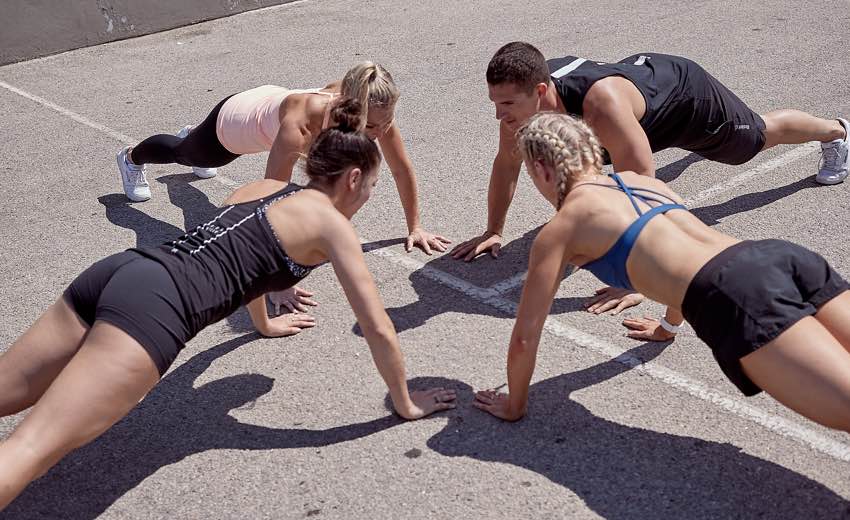
Despite misconceptions, new research shows knee push-ups are in fact an effective way of building strength and a useful gateway for members to progress towards push-ups on their toes.
“Go hard, or go home,” was a popular mantra for many clubs in years gone by, often leaving those members who could only ‘go half-way’ to dejectedly take the latter option.
Thankfully for the public – and for penetration rates – those days are long gone, with the modern club a much more inclusive space that caters for all manner of ages and abilities.
But some notions are more difficult to dispel. For many, the debate still continues over whether less challenging and more inclusive versions of exercises – often known as ‘options’ – are actually worthwhile and provide any physiological results.
Chief among these is the much-maligned knee push-up. which has often been dismissed as pointless and offering no real benefit for building strength.
But the jury is no longer out. According to new exercise research published this month in the Journal of Applied Biomechanics, knee push-ups do in fact provide significant benefits in building and maintaining strength in both the upper body and core.
Significant benefits
The results show that while overall muscle activation is greater during the toe push-ups – due to the extra load on the upper body – the contribution from each of the muscles was similar for the two variations. This means exercisers are training the target muscles in the same way, just using less load when on their knees and reducing the risk of injury if they are not yet strong enough to ensure proper hip and neck alignment on their toes.
“Knee push-ups have long been considered an easy version without the same benefit as toe push-ups, but now we have the data to demonstrate the benefits for safe training,” says Jinger Gottschall, Associate Professor at Penn State University and lead researcher of the study.
“We were able to demonstrate that the overall ratio of muscle activation in the upper body when you do a push-up on your knees or toes is actually the same. It shows that knee push-ups are a surprisingly valuable alternative if you cannot perform a push-up on your toes with proper technique.”
For club operators, the research underpins the potential of modified exercises to serve as an inclusive gateway into the gym and group exercise studio for the large number of novice exercisers – such as older adults or first-timers – who want to start building their fitness levels without feeling left out.
Path of progression
The researchers also concluded that if a person performs enough knee push-ups to reach a point of fatigue, they will eventually become strong enough to do push-ups on the toes. Because the muscle activation pattern in both types of push-ups is similar, starting with knee push-ups can deliver initial results and aid member progression towards full toe push-ups.
“Our advice would be don’t leave push-ups out of a workout just because they cannot yet be performed on toes,” adds Gottschall.
“Knee push-ups are a valuable alternative to toe push-ups in order to give the chest, shoulders and arms a quality workout, at the same time strengthening the muscles of the core.”
In the study – conducted at FITOLOGY studio in Pennsylvania and supported by Les Mills International – 12 healthy male participants who completed strength training twice per week were measured using electromyography (EMG) signals while performing push-ups on both the knees and the toes.
EMG records the electrical activity of muscle using surface electrodes attached to the skin. The study participants completed a five-minute warm-up on a stationary bike and then completed a series of push-ups on the knees and toes as well as bench presses.
As well as finding comparable ratios of muscle activation between the two variants, the researchers also found push-ups to be more effective as a functional exercise than the bench press. Study participants experienced 51 percent more activation of the abdominal muscles when completing push-ups versus bench press repetitions.
A link to the paper published in the Journal of Applied Biomechanics is available here.
And to stay up to date with the latest research findings keep visiting the Les Mills website and to learn more about our past work check out lesmills.com/ae/research
Download the push-up study research collection
To access a consumer-facing version of this article, plus a range of social media and image assets that can be used to market the benefits of HIIT training to your club's members and prospects.



.webp)