Eccentric loading: The misunderstood strength-building method

Eccentric loading, slowing the lowering phase of a movement, is often blamed for post-workout soreness. But the science tells a different story: it’s a highly effective way to build strength, improve performance, and reduce injury risk, all with less fatigue.
The reality is, if you get the approach right, eccentric loading can be an exceptionally powerful tool for building strength, improving performance, and supporting long-term health – for everyone from athletes to beginners.
Key facts
- Eccentric loading can build strength with less effort
- It's an effective approach for everyone, from athletes to beginners
- Your body responds quickly
- You can get the benefits of eccentric loading through everyday activties
- Muscle soreness isn't necessarily linked to muscular adaptation.
Exercise scientist Professor Kazunori Nosaka of Edith Cowan University has delved deep into the world of eccentric exercise, producing a comprehensive 2026 review published in the Journal of Sport and Health Science. This review challenges many of the long-held assumptions around how it works and what it does to the body.
According to Nosaka’s findings, the takeaway is clear: while there can be temporary soreness born from eccentric loading, it’s not inherently harmful. In fact, when introduced progressively, this type of training delivers a highly effective stimulus for building strength and improving performance – without the strain many associate with hard training.
What is eccentric loading, and how does it work?
To understand eccentric training, it helps to start with its counterpart, concentric training. In most exercises – whether you’re pressing, squatting or pushing through a set of push-ups – we tend to naturally focus on the concentric phase. This is the effort phase where the muscle shortens and you overcome gravity to push up and out of the movement.
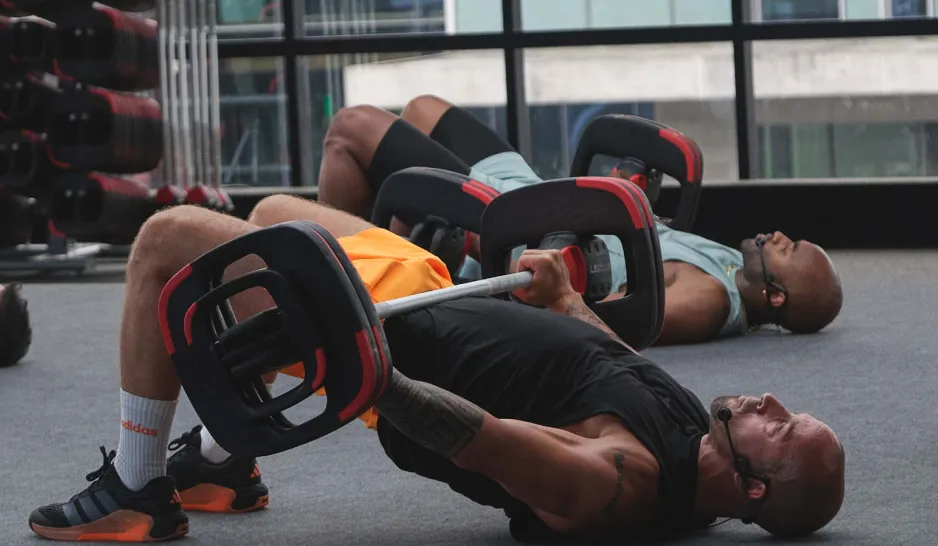
The eccentric phase is the opposite. It’s where the muscle lengthens under tension as you resist gravity. Good examples are when you lower into a squat, or bring the bar back to your chest during a press.
Eccentric loading simply means slowing down and deliberately controlling this phase of the movement.

Why eccentric loading is so effective for building strength
Eccentric loading is a great way to build strength with less strain. This is because, when our muscles lengthen under load, they can handle greater forces than during lifting. The result is a strong stimulus for muscles and tendons, with less exertion. In practical terms, you get more total quality work before tiring. It’s an efficient way to build strength – for both athletes and everyday exercisers.
Does eccentric training really cause more muscle soreness?
Eccentric exercise is often associated with delayed onset muscle soreness (DOMS). That’s the sore achy feel that usually peaks 24–72 hours after training. It’s the kind of pain you’ve likely felt walking down stairs or squatting to sit on the toilet.
Bryce Hastings, Les Mills Head of Research, says that while eccentric exercise certainly can contribute to DOMS, this type of soreness is often less about eccentric loading itself, and more about sudden increases in intensity, volume, or unfamiliar movement. Nosaka’s research supports this. It indicates that discomfort is more likely linked to irritation and inflammation in the connective tissue surrounding the muscle (where pain-sensitive nerve endings are located) rather than widespread muscle damage.
“It suggests soreness and muscle adaptation are not directly linked. So the idea of having to feel sore after a workout isn’t necessary for making progress,” says Hastings.
Good news… Your body handles eccentric training exceptionally well
One of the standout features of eccentric training is how quickly the body learns to tolerate it. It only takes a couple of sessions for the muscles, tendons, and the nervous system to adapt through what’s known as the repeated bout effect. This means, if you repeat the same eccentric-focused workout days or weeks later, you’ll typically experience significantly less soreness. Such fast, protective adaptation is a key reason eccentric training becomes more comfortable (and more effective) over time.
The downside of eccentric loading
If eccentric loading has a drawback, it’s that it can be deceptive. Because perceived exertion is lower, it’s easy to do too much, too soon. High loads, high volume, and fast eccentric movements are what tend to drive excessive soreness.
You can easily avoid this by starting light with lower loads and fewer repetitions. Then build gradually, prioritizing control and technique before increasing intensity. Done this way, eccentric training becomes not just safe, but one of the most effective interventions available.
Why athletes love eccentric loading
Eccentric strength underpins some of the most important athletic qualities. It’s linked to improved braking strength, force absorption, and change-of-direction efficiency. These benefits are particularly important for athletes or anyone who plays sports or does high-speed or high-impact training.
Eccentric loading also plays a key role in injury prevention, especially in muscles and tendons that decelerate movement, like the hamstrings. And interestingly, it also has a powerful effect in rehabilitation. Exercise scientists have noted a unique transfer of strength, where training one limb can help preserve or even build strength in the opposite, untrained limb. This makes it a valuable tool during injury recovery.
It’s accessible, scalable, and effective for all
While often associated with elite performance, eccentric training is arguably even more valuable for general health. Like all types of strength training, it improves muscle strength and power, balance and functional ability, plus cardiovascular and metabolic health. But the fact that it does so with lower energy cost and less perceived exertion makes it particularly appealing and sustainable. That is why it’s well-suited to beginners, older adults and anyone returning to exercise.
How to add eccentric loading to your training
You don’t need to overhaul your routine to enjoy the benefits. Anytime you’re doing strength exercises, simply start by slowing the lowering phase of the movement. For example:
- Take 3-4 seconds to descend into a squat
- Slowly lower weights with control in presses
Many LES MILLS™ programs integrate eccentric loading through controlled tempo, expert coaching, and structured progression, so you can enjoy the benefits of this type of training safely and consistently.
- BODYPUMP™ uses high reps and controlled tempos (often with slower eccentric phases) to maximize time under tension
- BODYPUMP HEAVY™ focuses on heavier loads with slow eccentric phases and longer recovery
- LES MILLS STRENGTH DEVELOPMENT™ incorporates targeted hypertrophy blocks with deliberate tempo work targeting eccentric phases
One of the most compelling aspects of eccentric training is how easily it can be embedded into daily life. Simple activities like walking downhill, taking the stairs down slowly and with control, and lowering into a chair instead of dropping also provide very real benefits. Even short, low-volume routines built around these controlled bodyweight movements have been shown to improve strength, flexibility, and long-term exercise consistency.
The key takeaway
The key takeaway is simple: muscle damage is not the goal; it is a byproduct that can be managed (Learn how to train effectively when you’re sore.)
You don’t need to feel exhausted or sore to make progress. What matters is applying the right stimulus, with control, and giving your body time to adapt. Eccentric training does exactly that.
Experience science-backed strength training when you try BODYPUMP, BODYPUMP HEAVY and LES MILLS STRENGTH DEVELOPMENT.
Find a class near you or try now at home using LES MILLS+.
FAQs:
Is eccentric training better than concentric training?
Both the eccentric and concentric phases of training provide valuable benefits. Eccentric loading allows muscles to handle higher loads with less energy, making it highly effective for building strength.
How slow should eccentric reps be?
Most research-backed protocols recommend 2-4 seconds for the lowering phase to maximize control and muscle tension.
Is muscle soreness a sign of a good workout?
No. Soreness is not a reliable measure of workout effectiveness. It is typically a result of increased workout intensity or new ways of moving. Progress comes from consistent, progressive overload.
Can beginners do eccentric training?
Yes. It is particularly effective for beginners because it builds strength with lower perceived effort, which makes it easier to adhere to.
Want more health and fitness insights?
Get monthly Fit Planet updates straight to your inbox.
Want more health and fitness insights?

Fit Planet
Exercise for mental health: What the research says about feeling happier, healthier, and more resilient
Fit Planet
How to become a group fitness Instructor: A step-by-step guide

Fit Planet
Why music makes exercise feel easier, more enjoyable, and more effective

Fit Planet
Are you eating enough to support your workouts? 7 signs you're under-fueling your training

Fit Planet
10 signs you'd make a great group fitness Instructor

Fit Planet
Does exercise help you lose weight? What the science really says

Fit Planet
How much strength training do you need to live longer? Scientists say 90-120 minutes per week

Fit Planet
TRAINING EN MENSTRUATIE: STEM JIJ JE TRAINING AF OP JE CYCLUS?
Fit Planet
When is the best time to exercise? Morning vs evening workouts explained
Fit Planet
What is CEREMONY HYROX? A complete guide to the new Les Mills x HYROX workouts

Fit Planet